Bitcoin is becoming financial infrastructure through regulated access, custody, accounting clarity and deeper market plumbing. The real shift is not risk disappearing, but risk moving into new layers.
MONEY NO SOFÁ — PREMIUM EDITORIAL
Bitcoin is gaining regulated access, accounting clarity, institutional custody, and deeper market plumbing. That does not make it safe. It changes the location of the risk.
Approx. 17–19-minute read
Bitcoin spent its first decade proving that a scarce digital asset could move without a central bank, corporate issuer, or national payment network. Its second decade is proving something more complicated: an asset designed to operate outside traditional finance can become deeply embedded inside it. Brokerage accounts offer exposure, listed products hold bitcoin for investors, public companies report qualifying crypto assets under clearer accounting rules, and professional custodians compete to secure private keys at institutional scale.
This is often described as adoption, as though the process were a straight line from niche experiment to conventional investment. The better description is integration. Bitcoin is being connected to the financial system through legal wrappers, market makers, custodians, accounting standards, settlement processes, derivatives, collateral policies, and treasury decisions. Each connection makes access easier. Each connection also creates a new point where incentives, leverage, operational failure, regulation, or concentration can matter.
The central mistake is to believe that institutionalization removes Bitcoin risk. It does not. It converts some risks into familiar financial forms while preserving the underlying volatility, protocol rules, custody choices, and market reflexivity. A regulated product can reduce the burden of holding keys without eliminating the risk of buying at the wrong price. A liquid market can improve execution while enabling more leverage. Corporate accounting can increase transparency while making reported earnings more sensitive to price swings.
The practical question is therefore not whether Bitcoin has become legitimate. It is how the asset behaves when it becomes infrastructure—and how an individual investor should respond when access gets easier than understanding.
The institutionalization paradox

Institutionalization creates a paradox. Bitcoin becomes easier to own precisely because more intermediaries stand between the investor and the network. A brokerage customer can gain price exposure without running a node, securing a seed phrase, evaluating wallet software, or moving coins on-chain. That convenience is real. It also means the investor owns a claim on a product whose sponsor, custodian, exchange, administrator, and authorized participants perform critical functions.
The network remains decentralized at the protocol level, but the access layer can become concentrated. Bitcoin may continue producing blocks even if a fund sponsor fails, yet an investor in that sponsor’s product still faces legal, operational, market, and liquidity consequences. A large custodian can secure assets professionally while creating a concentration point for attackers, regulators, counterparties, and operational mistakes.
The paradox is not a reason to reject financial products. It is a reason to identify which problem each product solves. An exchange-traded product can solve convenience, tax reporting, portfolio integration, and brokerage access. Direct ownership can solve control, portability, and resistance to a single intermediary. Neither form is universally superior. They expose the holder to different failure modes.
A mature Bitcoin strategy separates network confidence from product confidence. Believing that the protocol will continue operating does not automatically justify every wrapper, custodian, valuation, or allocation built around it.
What spot Bitcoin products changed

The United States Securities and Exchange Commission approved the listing and trading of multiple spot bitcoin exchange-traded products in January 2024. The approval did not endorse Bitcoin, and the SEC explicitly warned investors about volatility and market risks. Yet market structure changed because traditional brokerage accounts gained a regulated route to spot exposure.
The importance was not simply new demand. The products required a professional operating chain: creation and redemption, custody, pricing benchmarks, disclosures, exchange surveillance, authorized participants, and daily liquidity. In July 2025, the SEC approved in-kind creations and redemptions for crypto exchange-traded products, allowing a process more similar to other commodity products and potentially reducing friction created by cash-only mechanisms.
These developments make Bitcoin easier to fit inside retirement accounts, advisory portfolios, institutional mandates, and treasury discussions. They also create feedback loops between the spot market, listed shares, derivatives, market makers, and large flows. When demand arrives through a fund, authorized participants and custodians translate financial demand into market activity. When redemptions accelerate, the same plumbing can transmit selling pressure.
For the individual investor, the lesson is not that a listed product is automatically safer or riskier than direct ownership. It is that the exposure is now part of a larger market machine. Fees, tracking behavior, custody disclosures, liquidity, tax treatment, and the investor’s legal rights become as important as understanding Bitcoin itself.
Accounting clarity changes corporate behavior

The Financial Accounting Standards Board issued ASU 2023-08 to require qualifying crypto assets to be measured at fair value each reporting period, with changes recognized in net income. The previous impairment-oriented treatment often recorded downside without reflecting subsequent recovery in the same intuitive way. The newer approach better aligns reported values with market economics for assets within its scope.
Accounting rules rarely create demand by themselves, but they change the cost of explaining a decision. A chief financial officer can model the impact of a Bitcoin allocation more clearly when the balance-sheet treatment is transparent and comparable. Investors can see holdings, restrictions, and changes more directly. Audit committees can frame controls around a defined standard rather than an improvised interpretation.
The trade-off is visible volatility. Fair-value changes can move through earnings, creating noisy results and pressure during sharp price swings. A company that uses Bitcoin as a long-term treasury asset must still explain why an asset with daily market volatility fits its liquidity needs, debt obligations, covenant structure, and tolerance for earnings variability.
Corporate adoption therefore depends on governance, not enthusiasm. Who can authorize purchases? Where are assets custodied? Is leverage permitted? How much operating cash remains protected? What disclosure is required? What event would force a sale? Accounting clarity makes these questions easier to ask. It does not answer them.
Custody becomes market infrastructure

Bitcoin custody begins with a simple fact: control of the relevant private keys determines the ability to move coins. At personal scale, that fact creates a choice between self-custody and relying on a service provider. At institutional scale, custody becomes a system of segregated wallets, policy controls, multi-party approval, key-generation ceremonies, backup procedures, insurance arrangements, audits, access logs, and legal agreements.
Professional custody can reduce individual errors. A person no longer needs to protect a seed phrase from theft, fire, loss, coercion, or accidental disclosure. An institution can distribute authority across people and locations, impose transaction limits, require independent approvals, and document succession and recovery.
But institutional custody creates concentration risk. Large pools of assets become attractive targets. Legal ownership, beneficial ownership, and operational control must remain aligned. A custodian can be technically secure while a client faces contractual limits, account freezes, jurisdictional disputes, or delays during a crisis. Insurance may cover narrow events rather than every form of loss.
The investor should read custody disclosures as carefully as fees. Who holds the keys? Are assets segregated? Can they be lent or pledged? What happens in insolvency? Which law governs the arrangement? How are forks, airdrops, and network events handled? In financial infrastructure, the custody contract is part of the investment.
Liquidity is useful until it becomes leverage

A deeper market usually improves price discovery and execution. Large orders can be absorbed with less slippage, and investors can enter or exit through multiple venues. Institutional market makers connect spot products, futures, options, and over-the-counter liquidity. This is a sign of maturity, but it also expands the amount of leverage that can be built around the asset.
Leverage changes the character of volatility. A price decline is no longer only a change in sentiment; it can trigger margin calls, liquidations, hedging flows, collateral sales, and automated risk reductions. The resulting selling may push prices below levels justified by long-term conviction. The reverse can occur during short squeezes and rapid inflows.
Bitcoin’s fixed issuance schedule does not prevent financial claims from expanding around it. Futures, options, loans, structured products, and collateralized positions can create exposure far larger than the amount of spot Bitcoin changing hands. This does not break scarcity at the protocol level, but it can make market behavior more elastic and reflexive in the short term.
For ordinary investors, the safest response is not to predict every liquidation cycle. It is to avoid becoming forced liquidity for someone else. Position size, low or zero leverage, emergency cash, and a defined time horizon are stronger defenses than confidence in a price target.
Price exposure is not the same as ownership
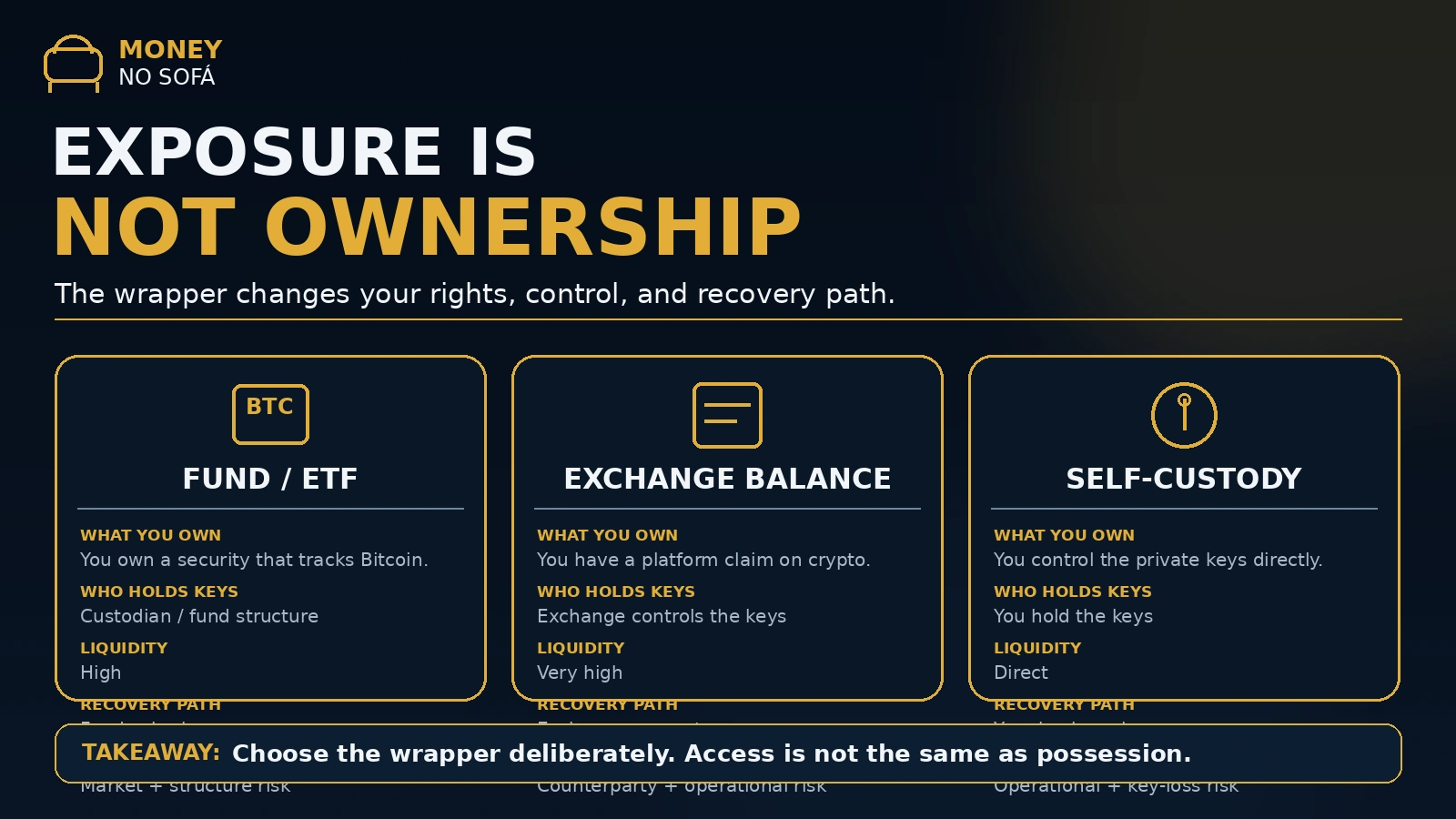
Price exposure means participating in Bitcoin’s gains and losses. Ownership means controlling an asset that can be transferred according to the network’s rules. A fund share, derivative, custodial account, and self-custodied coin can all provide economic exposure, but they do not provide the same rights or operational capabilities.
A person who wants portfolio diversification may prefer a regulated product inside an existing account. A person who wants to move value globally, verify holdings on-chain, or reduce dependency on an intermediary may prefer direct ownership. Someone may reasonably use both: a long-term self-custody allocation and a smaller liquid position in a brokerage account.
Confusion occurs when investors buy one form and assume they possess the properties of another. A fund investor cannot generally withdraw the underlying Bitcoin. A custodial exchange user may be able to withdraw, but only while the platform supports the transaction and the account remains accessible. A self-custody holder has direct control but also bears direct responsibility for security and inheritance.
The right instrument should match the intended job. Buying a wrapper for convenience and then criticizing it for not providing sovereign control is a category error. Buying direct Bitcoin without a recovery plan and calling it freedom is equally incomplete.
A practical allocation framework
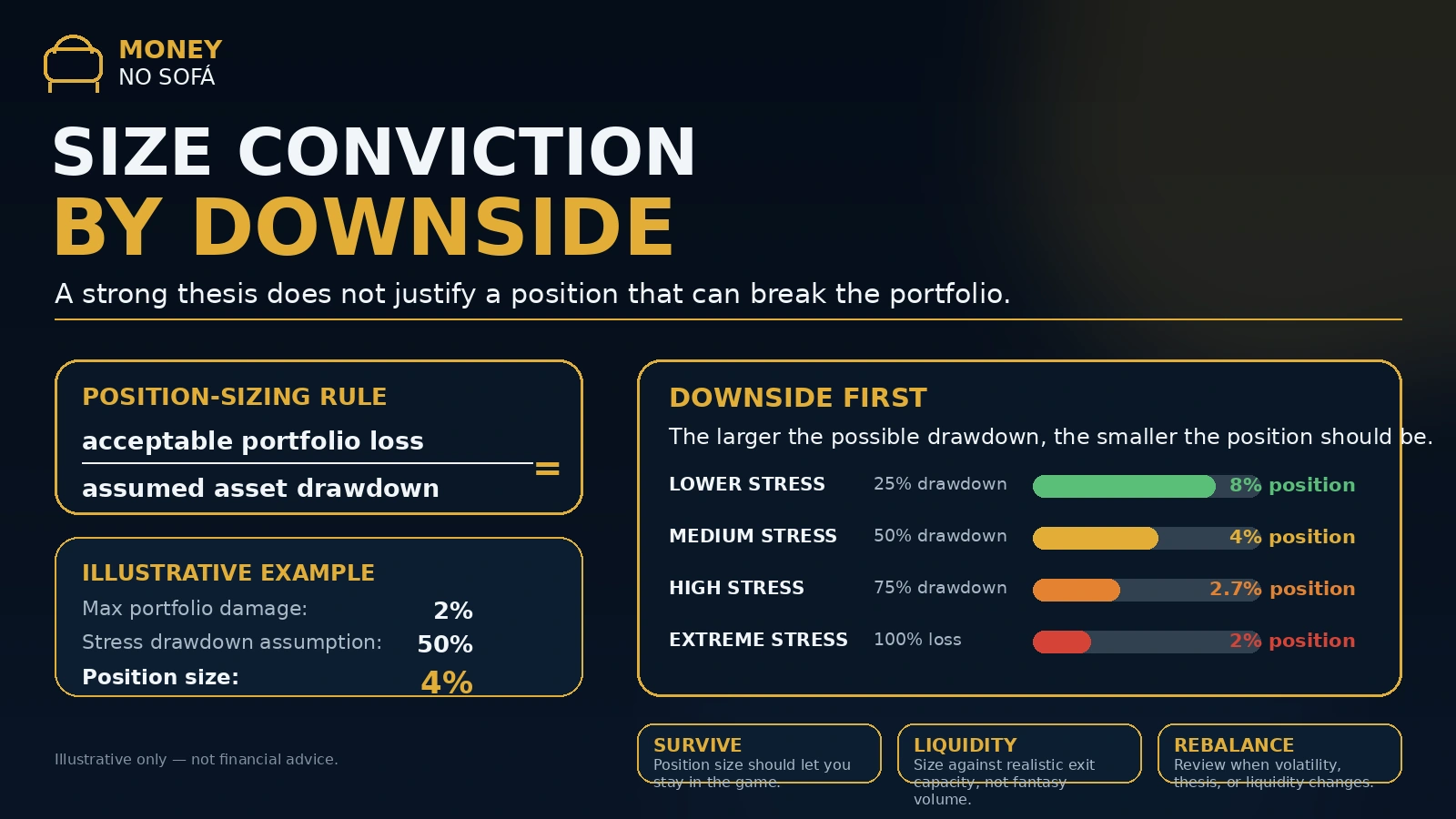
Bitcoin allocation should begin with financial resilience. An investor who lacks emergency savings, carries expensive debt, or may need the money within a short period is poorly positioned to absorb volatility. The asset can fall sharply while the long-term thesis remains intact. A forced seller experiences the drawdown as a permanent loss.
A useful framework separates four questions: conviction, capacity, custody, and cadence. Conviction describes why Bitcoin belongs in the portfolio. Capacity describes how much loss the household can absorb without damaging essential goals. Custody identifies the form of ownership and its failure modes. Cadence determines whether purchases happen gradually, tactically, or in one allocation.
The allocation should be tested against scenarios. What happens if Bitcoin falls 60%? What happens if it doubles and becomes an oversized portion of the portfolio? What happens if a custodian freezes withdrawals? What happens if the investor dies and the family cannot access the keys? What happens if tax rules change?
Good sizing makes uncertainty survivable. It permits the investor to continue thinking during volatility rather than becoming emotionally dependent on the next price move.
- Protect liquidity first: keep emergency cash outside volatile assets.
- Define maximum exposure: set a range and rebalance rules before excitement arrives.
- Choose custody deliberately: convenience, control, and recovery are separate objectives.
- Avoid hidden leverage: loans, derivatives, and collateralized products can force sales.
- Document inheritance: access should survive death or incapacity without exposing keys today.
How to evaluate a market venue
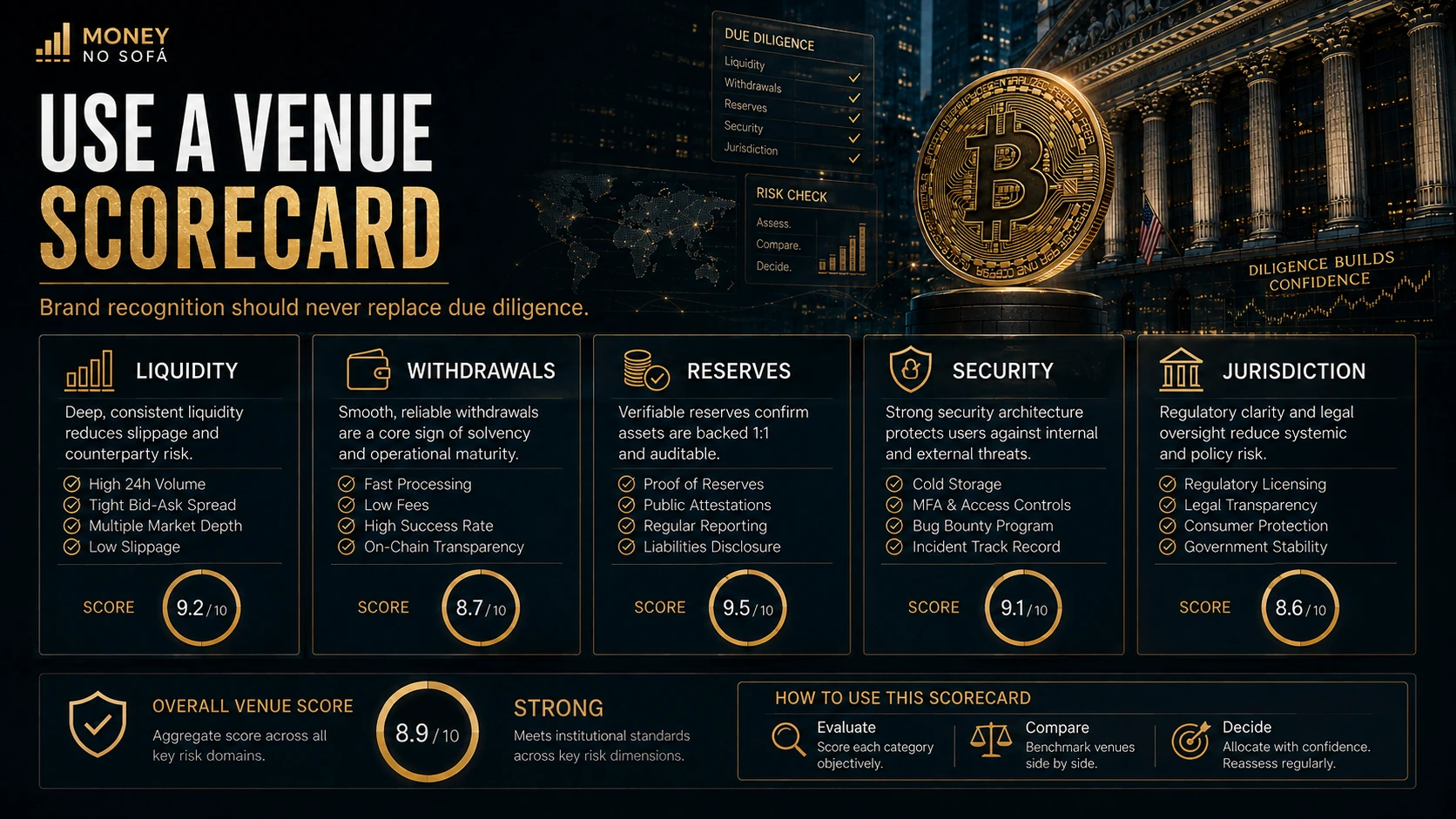
When buying Bitcoin directly, the venue affects execution, custody, withdrawals, compliance, and access to information. The headline trading fee is only one variable. A strong evaluation includes local availability, fiat deposit and withdrawal methods, spread, depth, security controls, proof-of-reserves transparency, account recovery, customer support, and the ability to withdraw Bitcoin to a self-custody wallet. Readers comparing direct market access can also review the current Binance registration offer using code BITCOIN15 and then verify the fees, products, withdrawal rules and eligibility available in their country.
Proof of reserves can improve transparency by helping users verify that balances are included in a cryptographic snapshot and that the platform controls on-chain assets. It is not a complete substitute for audited financial statements, liability analysis, governance, or legal protections. A snapshot cannot prove how a company behaves between snapshots or how every off-chain obligation is structured.
The practical test is operational. Deposit a small amount, buy a small amount, enable strong authentication, create an address allowlist, and test a withdrawal before using a venue for a larger position. Record fees and processing times. Verify official domains and avoid links sent through unsolicited messages.
A venue should make the investor’s process easier without becoming the entire strategy. Long-term holdings, trading balances, and cash-management needs may deserve different locations.
A practical place to compare the market
Binance can be used to compare Bitcoin and crypto markets, review available pairs, and test a small purchase-and-withdrawal workflow. Start with a limited amount, enable every available security control, and confirm the rules that apply in your country.
Check the current Binance referral offer with code BITCOIN15.
Availability, eligibility, fees, products, and referral benefits vary by country and account. Crypto assets are volatile and may result in loss.
Institutional adoption does not cancel volatility
A recurring narrative claims that institutional participation will permanently reduce Bitcoin volatility. Deeper liquidity may moderate some movements, but institutions can also trade quickly, hedge aggressively, rebalance systematically, and withdraw capital when risk limits change. Institutional money is not automatically patient money.
Listed products can attract long-term allocators and short-term tactical flows. Corporate treasuries can create durable demand or become leveraged proxies for Bitcoin sentiment. Derivatives can distribute risk or amplify liquidation cascades. The same infrastructure that normalizes the asset also creates channels through which macroeconomic shocks, interest-rate changes, and portfolio deleveraging reach it faster.
Volatility should therefore be treated as structural rather than temporary. Bitcoin trades continuously across jurisdictions and investor types. It has no central bank smoothing mechanism and no cash flow that anchors valuation through conventional discounted models. Narratives, liquidity, adoption, regulation, and leverage interact in real time.
The investor does not need to fear volatility, but must finance it. A position that can survive a large drawdown without forcing a sale is fundamentally different from a position funded by borrowed money or short-term obligations.
The infrastructure checklist

Before buying, write down the complete ownership chain. Identify the account, product, custodian, legal entity, jurisdiction, fees, withdrawal rights, recovery process, tax records, and inheritance plan. This exercise exposes assumptions that are invisible during a rising market.
For a listed product, review the prospectus, sponsor fee, custody arrangement, creation and redemption structure, trading liquidity, and tracking behavior. For an exchange account, review proof-of-reserves information, withdrawal policies, authentication, allowlisting, and local regulatory status. For self-custody, document wallet setup, backups, device security, test recovery, and succession.
Then define monitoring. A long-term investor does not need to watch the price every hour, but should review product changes, custody notices, regulatory developments, and allocation drift. Security controls should be revisited after changing phones, email addresses, or devices.
Infrastructure is reliable when it is boring, documented, and tested. The worst time to discover a missing recovery code or misunderstood withdrawal rule is during a market panic.
- State the purpose of the Bitcoin allocation in one sentence.
- Select the ownership form that matches convenience, control, and recovery needs.
- Test the full path from deposit to purchase to withdrawal or sale.
- Set risk limits for allocation, leverage, and counterparty exposure.
- Document succession without exposing credentials to unnecessary people.
- Review annually or after any material product, legal, or security change.
Frequently asked questions
Does institutional adoption make Bitcoin safe?
No. Institutional products can improve access, disclosure, custody, and liquidity, but Bitcoin remains volatile and the products introduce sponsor, custodian, market, legal, and concentration risks. Institutionalization changes the form of risk rather than removing it.
Is a spot Bitcoin product the same as owning Bitcoin?
No. A listed product normally provides price exposure through shares. Direct ownership can provide on-chain transferability and control of private keys. The trade-off is that direct ownership requires operational security and recovery planning.
Should every investor use self-custody?
No. Self-custody can reduce intermediary risk, but it creates personal responsibility for keys, backups, transactions, and inheritance. The correct arrangement depends on competence, objectives, value at risk, and the need for direct control.
How much Bitcoin is reasonable?
There is no universal percentage. A reasonable allocation is one that can experience a severe drawdown without damaging emergency liquidity, debt obligations, retirement timing, housing, education, or other essential goals.
What should be tested before using an exchange?
Test identity verification, fiat deposit, a small purchase, security settings, address allowlisting, a small withdrawal, and statement export. Confirm the exact entity and rules serving your country.
Why does infrastructure matter to price?
Infrastructure changes who can buy, how positions are financed, how quickly capital moves, how assets are custodied, and how leverage is created. These channels can support demand and amplify both upward and downward moves.
Questions sophisticated investors should still ask
Institutional access can create the impression that the difficult questions have been outsourced. They have not. An investor should still ask how Bitcoin fits with income, debt, retirement timing, tax residence, and family responsibilities. A product approval answers whether an instrument can trade under a regulatory framework; it does not answer whether the allocation is suitable for a specific household.
Ask how the position behaves inside the total portfolio. Bitcoin can diversify some traditional exposures over certain periods and become highly correlated with speculative risk during others. The relationship changes with liquidity, interest rates, leverage, and market structure. Historical correlations should be treated as observations, not promises.
Ask whether the thesis depends on price appreciation alone or on a broader monetary function. If the thesis is digital scarcity, define the evidence that strengthens or weakens that role. If the thesis is institutional demand, monitor product flows and competing vehicles. If the thesis is protection from financial repression, understand the custody and jurisdiction choices required to preserve that property.
Finally, ask what success looks like. A position that rises tenfold can create concentration and tax consequences. A disciplined plan includes rebalancing, debt reduction, charitable giving, or other uses of gains. Financial infrastructure is valuable when it supports life objectives rather than replacing them.
The real transition
Bitcoin is becoming financial infrastructure because traditional finance has learned how to package, custody, account for, trade, and distribute exposure to it. That transition expands access and can improve transparency. It also creates concentration, leverage, product, and intermediary risks that did not exist in the same form when Bitcoin circulated mainly among technically sophisticated users.
The network’s independence and the investor’s independence are not the same thing. A decentralized protocol can be accessed through highly centralized channels. A regulated wrapper can be useful without delivering self-sovereignty. Direct ownership can provide control without providing operational competence.
The mature position is not to choose a slogan. It is to choose the right ownership system, position size, and risk controls for the job Bitcoin is expected to perform. Infrastructure makes participation easier. Discipline determines whether easier access becomes durable wealth or a faster route to an avoidable loss.
A practical place to compare the market
Readers who want direct market access can use Binance as one venue to compare liquidity, fees, supported assets, and withdrawal options. Treat registration as the beginning of due diligence, not the end of it.
Check the current Binance referral offer with code BITCOIN15.
Availability, eligibility, fees, products, and referral benefits vary by country and account. Crypto assets are volatile and may result in loss.
Go beyond the price chart.
Two Money no Sofá eBooks map the custody, government, institutional and geopolitical power layers forming around Bitcoin.
Educational notice: This article is general editorial information, not personalized financial, investment, legal, accounting, tax, or security advice. Crypto products, rules, prices, and availability can change rapidly.
Selected sources
Continue Learning About Bitcoin
For the investor perspective, read about institutional Bitcoin adoption. To understand the wider role of financial intermediaries, explore Bitcoin vs banks.
For a book-length introduction to Bitcoin’s origins, Satoshi and the ideas behind money, explore The Bitcoin Trilogy — Complete Set.
The headline is only the start.
Ask Nova what this story could change in your budget, savings, debt, investments or next purchase.