Altcoin market capitalization can hide weak liquidity, shallow exits, token unlock pressure and exchange dependence. Learn how to evaluate the exit before entering.
MONEY NO SOFÁ — PREMIUM EDITORIAL
An altcoin can display a billion-dollar market capitalization while offering only a thin, fragile path to the exit. Market cap is a headline. Liquidity determines what your position may actually be worth.
Approx. 17–19-minute read
Crypto markets make valuation look simple. Multiply token price by circulating supply and a market capitalization appears. Rank the number against other projects, compare it with a larger coin, and imagine the upside if the gap closes. The calculation is easy. The conclusion is often false.
Market capitalization tells you what the circulating supply would be worth if every token could be valued at the latest marginal trade. It does not tell you how much money entered the asset, how much can leave without moving the price, who controls the remaining supply, whether reported volume is real, or what happens when a major venue removes the trading pair.
This is the altcoin liquidity trap. A position appears valuable on a screen because a small number of trades establish a price. When holders attempt to sell, the available bids may be shallow, spreads may widen, market makers may retreat, and unlocks may add supply precisely when demand is weakest. The displayed wealth can disappear before the position is converted into usable cash.
The trap affects small retail positions and professional funds differently, but the core rule is the same: the exit is part of the asset. This article explains how to evaluate depth, volume quality, unlocks, concentration, exchange dependence, and portfolio liquidity before a narrative becomes a stranded position.
Market capitalization is not money in the market
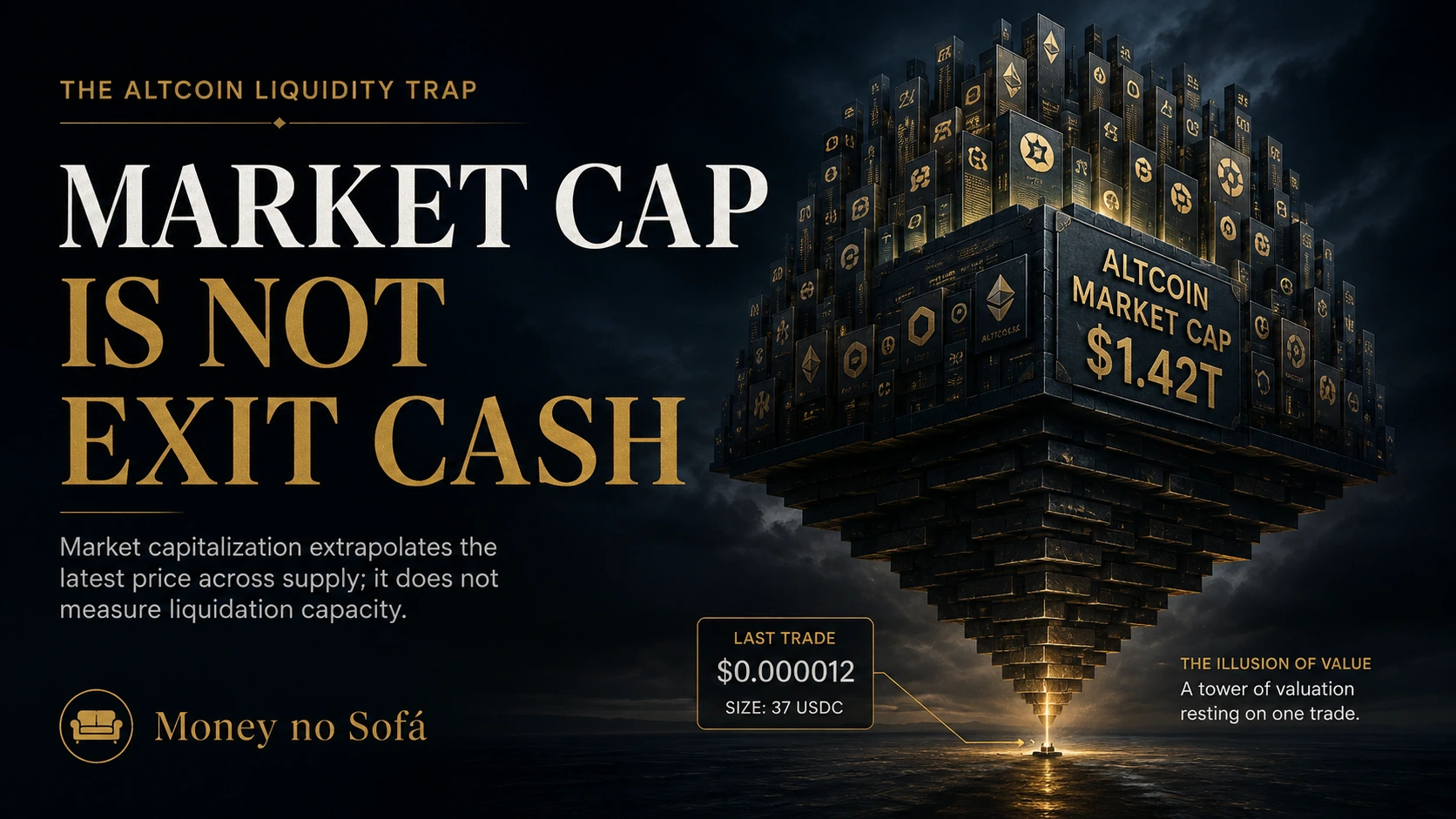
Suppose a token has 100 million units in circulation and the last trade occurs at ten dollars. The market capitalization is one billion dollars. That does not mean one billion dollars has been invested. It means the current marginal price, applied to the reported circulating supply, produces that number.
If only a few thousand tokens trade near ten dollars, the price can remain high while most of the supply never changes hands. A holder attempting to sell one million tokens encounters bids at progressively lower prices. The average realized price may be far below the headline quote.
This distinction is not unique to crypto, but crypto amplifies it through thin venues, fragmented markets, inconsistent supply reporting, concentrated ownership, and around-the-clock speculation. A token can reach a large ranking before its market develops the depth expected from an asset of that apparent size.
Market cap is useful for relative scale when supply data is credible and liquidity is considered separately. It becomes dangerous when treated as a pool of money available to every holder.
Order-book depth reveals the real exit
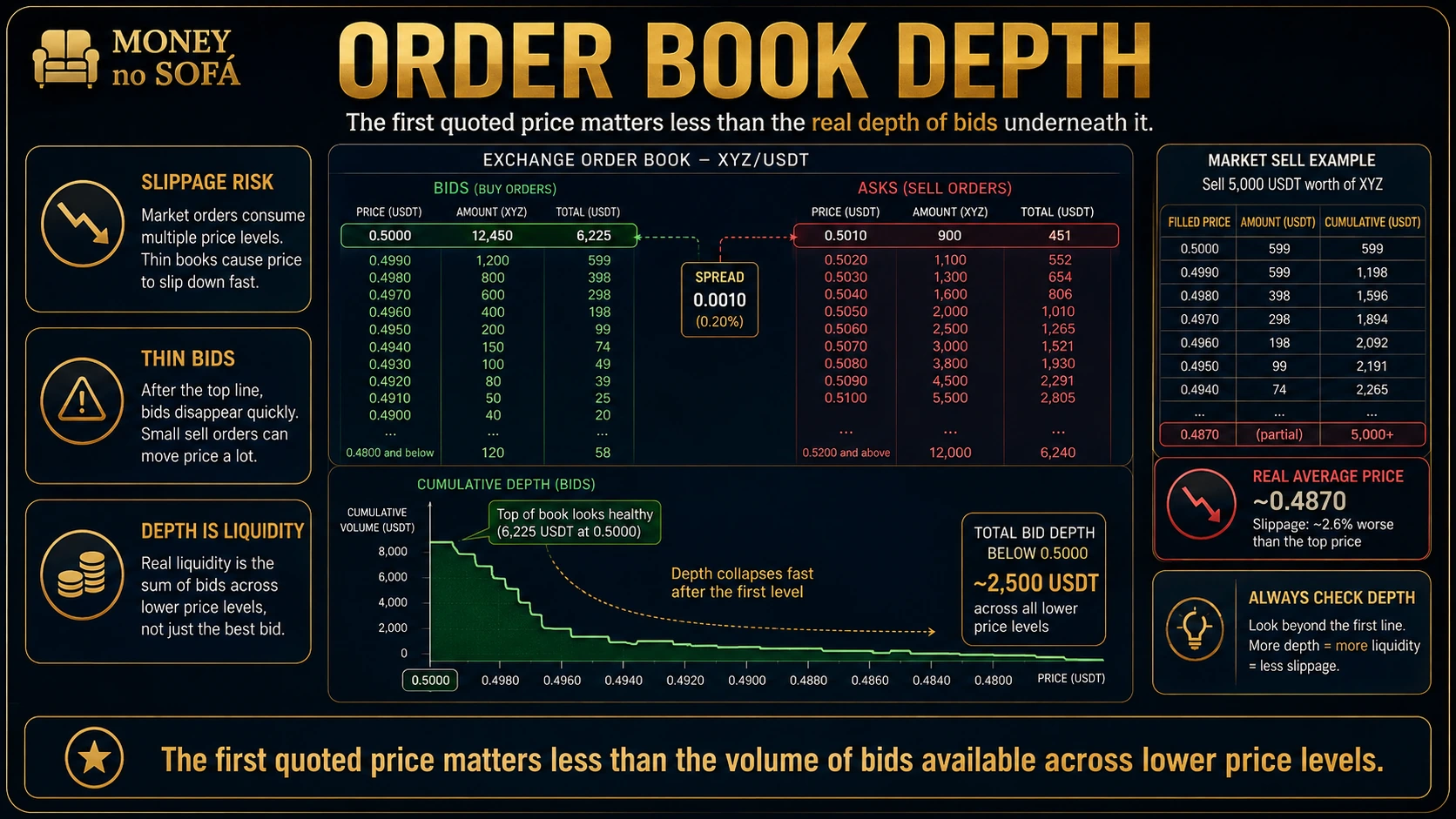
An order book displays offers to buy and sell at different prices. The spread is the distance between the best bid and best ask. Depth measures how much quantity is available around the current price. Slippage is the difference between the expected price and the average execution price of an order.
A liquid market can absorb a meaningful order with limited slippage. A thin market may show a tight spread for a small amount while offering little depth behind it. One market order can sweep through several price levels and print a dramatic decline.
Evaluate depth at practical thresholds: one percent, two percent, five percent, and ten percent from the mid-price. Ask how much value can be sold before reaching each level. Compare that amount with your intended position and with the likely behavior of other holders during stress.
Visible depth is not guaranteed. Orders can be canceled. Market makers can withdraw when volatility rises. An exchange interface may aggregate only one venue while liquidity exists elsewhere behind different access and counterparty conditions.
Use limit orders for illiquid assets and understand that a limit protects price, not execution. A sell order may remain unfilled while the market moves away.
Reported volume can be deceptive
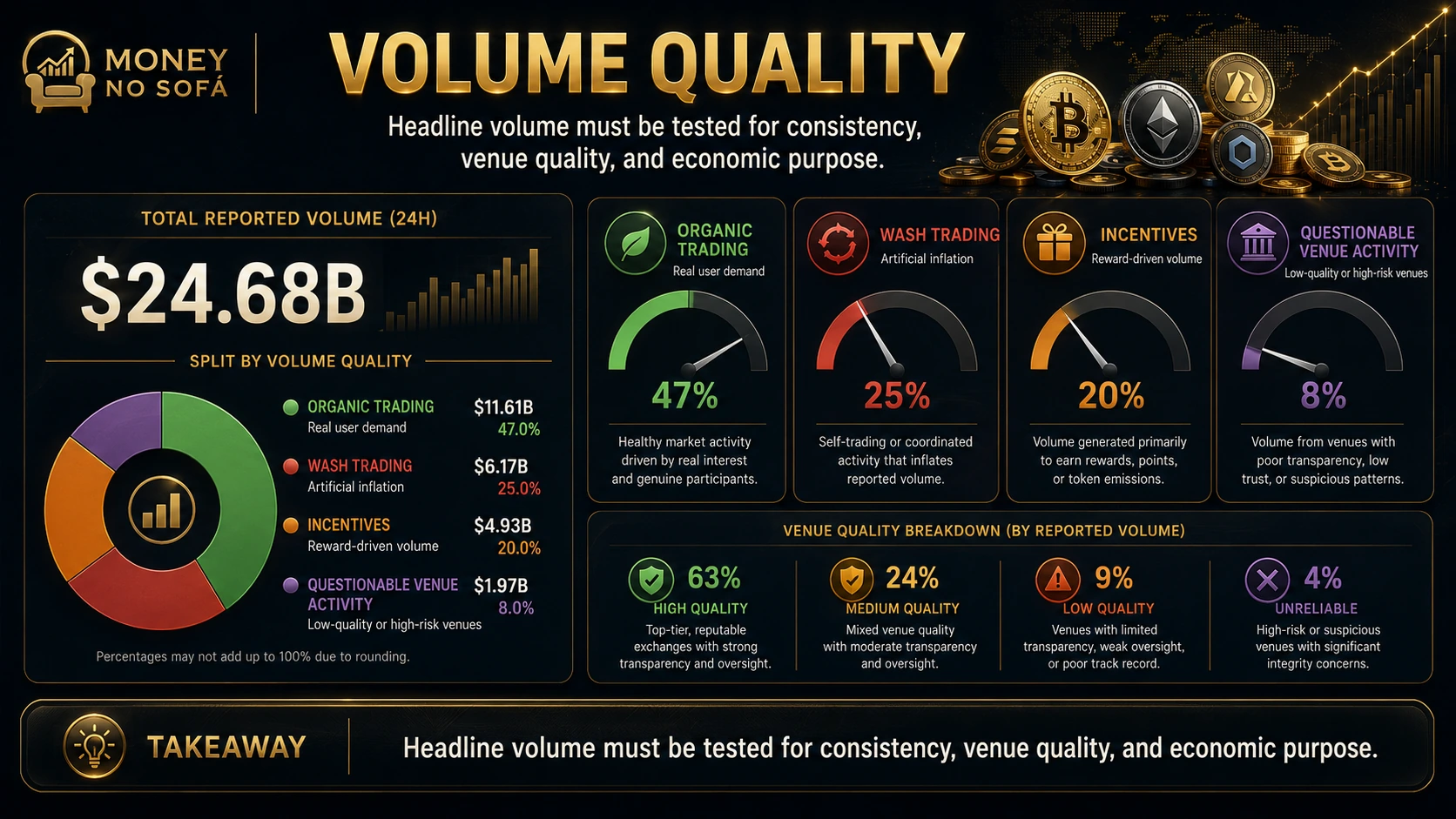
Twenty-four-hour volume is commonly used as a shortcut for liquidity. It can help, but the number can be inflated by wash trading, zero-fee promotions, market-maker churn, derivatives activity that does not support spot exits, or a brief speculative event.
Volume quality is visible through patterns. Organic markets usually show activity across time, several credible venues, reasonable spreads, and a relationship between volume, volatility, and news. Artificial activity may repeat in mechanical sizes, concentrate on obscure exchanges, or disappear when incentives end.
Compare spot volume with derivatives volume. A token can have active perpetual futures while the underlying spot market remains shallow. Derivatives support hedging and speculation, but settlement, liquidations, and funding can intensify volatility rather than create a reliable cash exit.
Look at volume over weeks, not one day. Examine the share held by the largest venue and pair. If most trading depends on one stablecoin pair at one exchange, operational or regulatory trouble at that venue can transform the market quickly. Eligible readers comparing live spot markets can review the current Binance registration offer with code BITCOIN15, then compare actual depth, spreads, volume quality and withdrawal support rather than treating a listing as an endorsement.
No single data source proves that volume is genuine. Use several venues, order books, trade prints, and on-chain transfers to build a more credible picture.
Low float and high valuation create a supply illusion
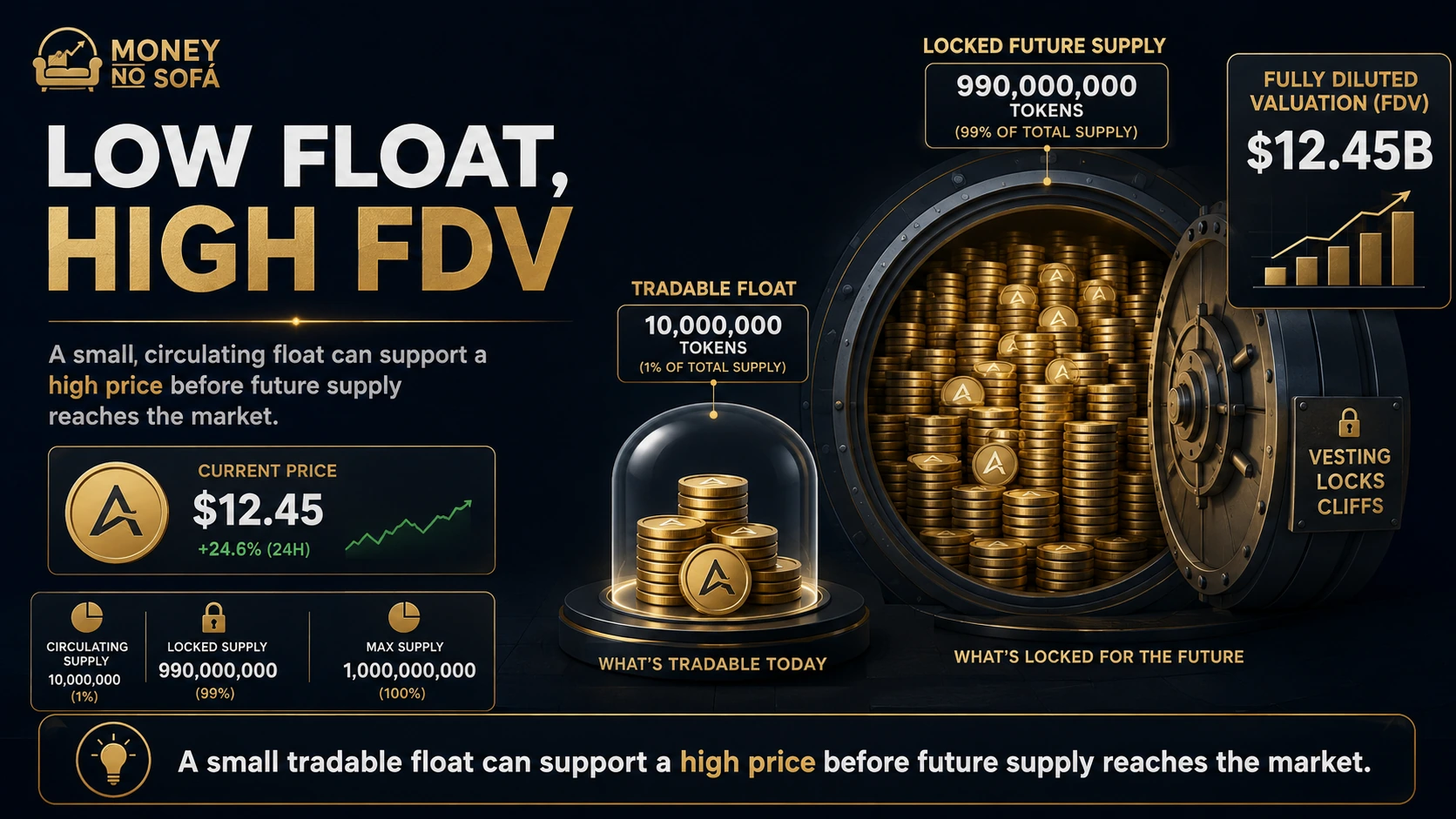
A token may launch with a small percentage of total supply circulating. The limited float can make price responsive to relatively modest demand. Multiplying that price by the full future supply produces a fully diluted valuation that may be many times larger than the current market cap.
Low float is not automatically fraudulent. Teams use vesting to align contributors and prevent immediate selling. The risk appears when valuation assumes strong future demand while large allocations to insiders, investors, foundations, treasuries, or incentives remain scheduled for release.
Unlocks do not guarantee a sell-off. Recipients may hold, stake, provide liquidity, or have strategic restrictions. But unlocks change the available choices. A market that can absorb today’s float may not absorb tomorrow’s supply at the same price.
Build an unlock calendar. Identify cliffs, monthly vesting, treasury emissions, staking rewards, and ecosystem incentives. Compare the dollar value of new supply at the current price with normal organic spot volume and visible depth. This reveals whether the market would need extraordinary new demand simply to maintain equilibrium.
Fully diluted valuation should be analyzed alongside utility and cash flow. A large future supply is less threatening when tokens are required for a genuinely expanding system. It is more threatening when utility consists mainly of incentives that create additional selling.
Market makers are not permanent buyers
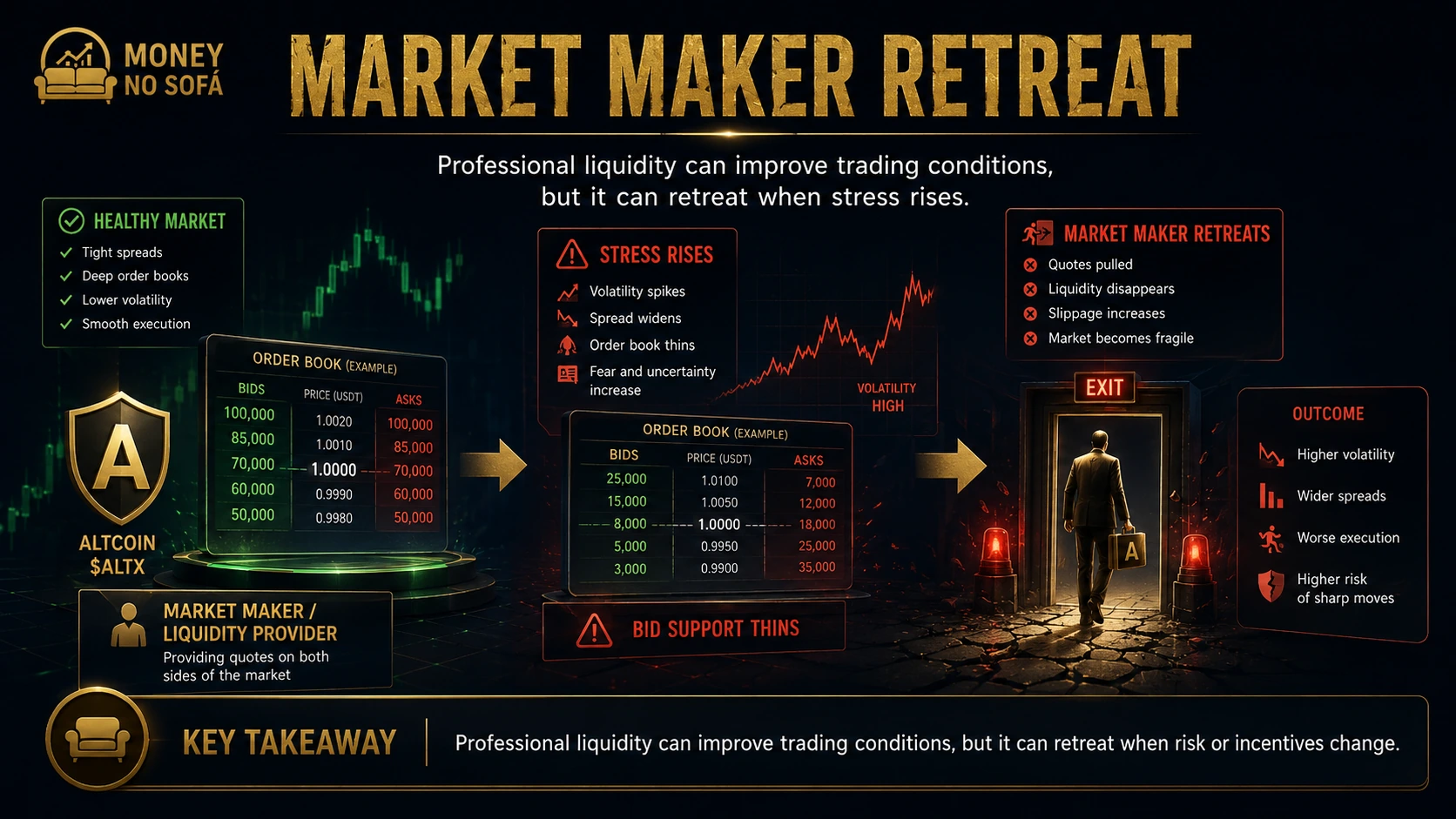
Projects often hire market makers to quote bids and asks, reduce spreads, and support orderly trading. This can make a new token appear liquid. The arrangement may involve token loans, options, performance targets, or fees. The economics are rarely visible to ordinary holders.
A market maker is not obligated to defend the token’s narrative or valuation. It manages inventory and risk. When volatility rises, borrow terms change, an exchange has problems, or the project relationship ends, quoted depth can shrink.
Some arrangements can create conflicts. Token loans and options may give a market maker unusual exposure. Incentives may reward volume rather than durable demand. A project may publicize liquidity without explaining how much depends on one firm.
Evaluate whether liquidity is distributed among independent venues and participants. A market supported by many natural buyers and sellers is more resilient than one relying on contractual quoting. Watch spreads and depth before and after incentive periods or major announcements.
Market makers are infrastructure. They can make trading more efficient. They cannot manufacture fundamental demand indefinitely.
Delisting risk changes the market overnight
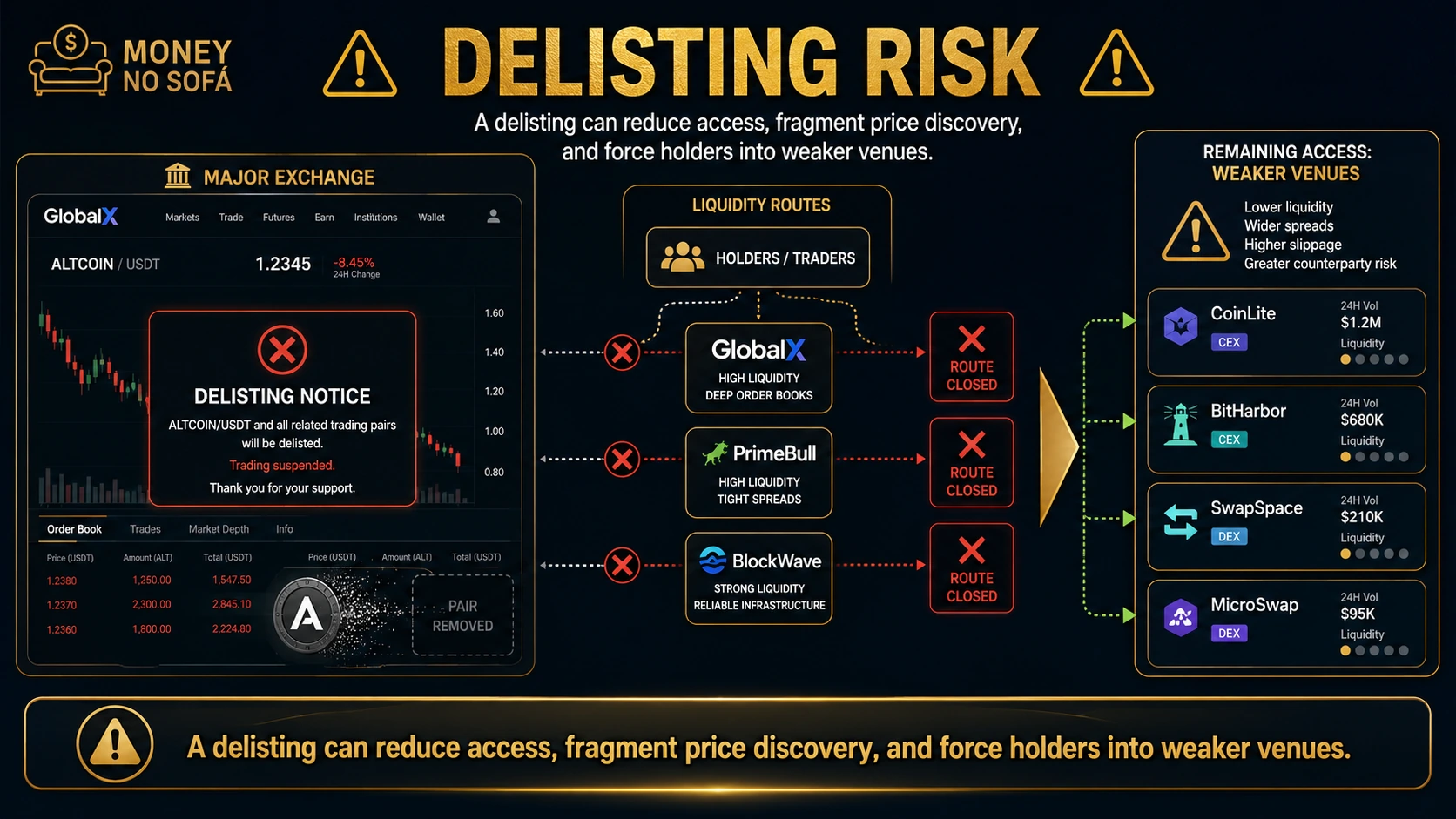
Exchanges review listed assets for factors such as team commitment, development activity, trading volume and liquidity, network stability, public communication, regulatory concerns, security, and responsiveness to due-diligence requests. When standards are no longer met, a token or trading pair may be removed.
A delisting does not necessarily destroy the protocol. Tokens may continue trading elsewhere or remain transferable on-chain. The economic impact can still be severe. A major venue may represent the dominant source of liquidity, price discovery, and fiat access.
Announcements can trigger immediate selling before the trading deadline. Other venues may follow. Deposits can close before withdrawals. Users who miss deadlines may need to self-custody or use unfamiliar exchanges with different risks.
Pair delisting and asset delisting are different. An exchange may remove a low-volume pair while retaining another market. Nevertheless, dependence on one pair, one stablecoin, or one region increases fragility.
Before buying, check where the token trades, which venues support withdrawals, whether the underlying network is operational, and how you would exit if the primary pair disappeared. A plan that begins after the announcement is already late.
Narrative liquidity disappears first

Altcoins often trade as narratives: artificial intelligence, gaming, real-world assets, modular blockchains, memes, decentralized physical infrastructure, or a new scaling design. Capital and attention cluster around the theme. Listings, influencers, incentives, and price momentum reinforce one another.
During the expansion, liquidity appears abundant because participants expect to sell to future participants. When attention rotates, the same token competes for bids against every other project in the category. Fundamentals may not have changed, but the marginal buyer has.
Narrative liquidity is strongest near the moment when risk feels lowest. Rising prices, active communities, and easy exits create confidence. That is precisely when position sizes can grow beyond the depth of the market.
Measure whether activity survives after rewards and social attention decline. Are users paying for the product? Are fees organic? Is developer activity meaningful? Does the token have a role beyond speculation? A narrative can introduce a real technology, but the token’s valuation still needs independent support.
Do not assume that a previous high is a natural destination. The historical price may have depended on liquidity conditions that no longer exist.
Concentration turns liquidity into a coordination problem
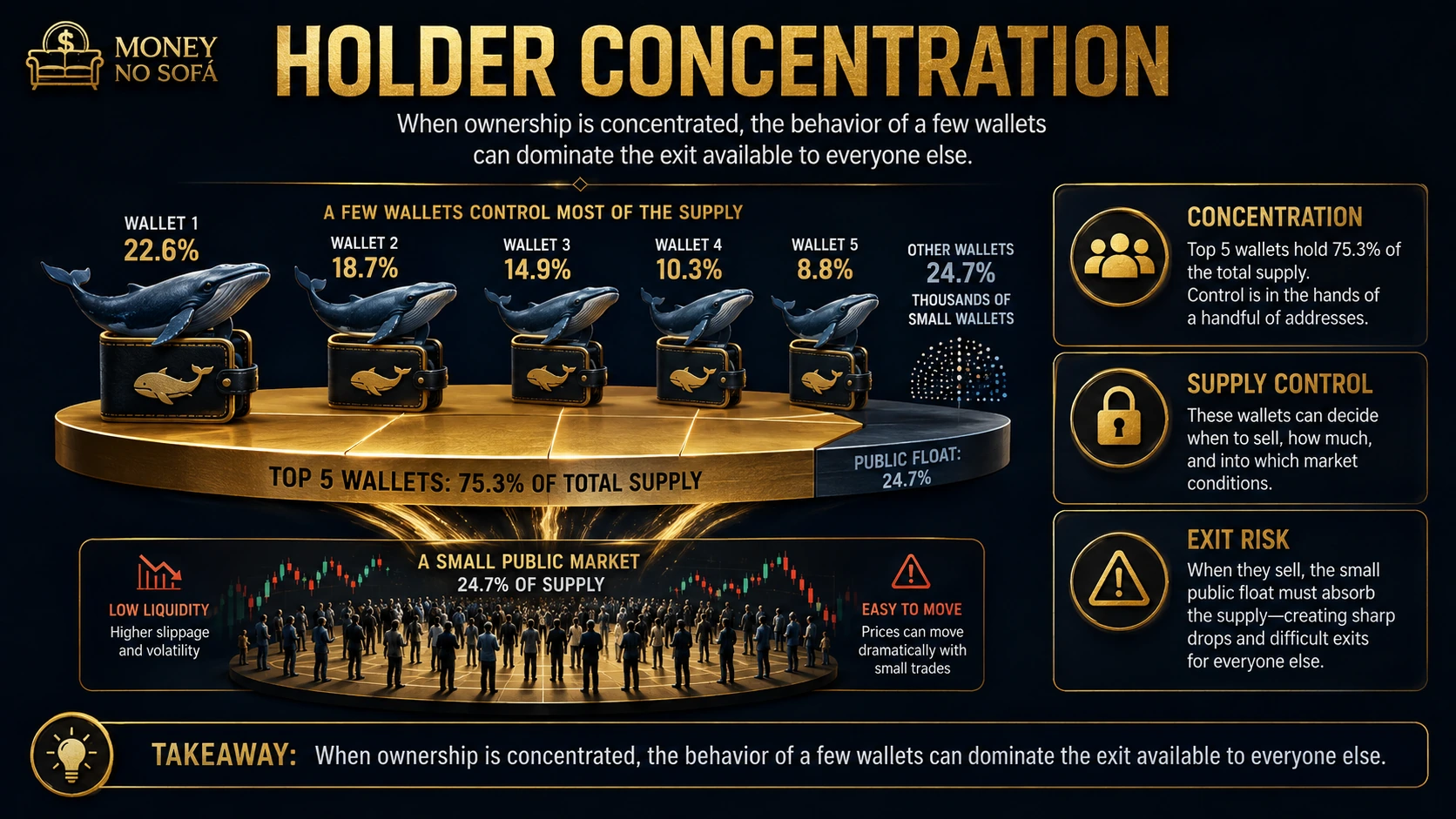
Holder concentration matters because liquid supply can be much smaller than circulating supply. Tokens may sit in foundation wallets, investor wallets, exchange wallets, bridges, staking contracts, treasuries, or a small number of whales.
Large holders do not need to sell everything to affect the market. Transfers to exchanges can change expectations. Collateral liquidations can force sales. Governance disputes can unlock previously inactive supply. A project treasury may sell tokens to fund operations.
On-chain concentration data requires interpretation. An exchange wallet represents many customers. A bridge contract may hold backing assets. A burn address is not an active holder. Label addresses where possible and focus on economically controlled supply.
The question is not merely who owns the token. It is whether their incentives align with yours and whether the market can absorb their potential activity. Vesting, disclosure, treasury policy, and public wallet monitoring can reduce uncertainty.
A concentrated asset can perform well. It is simply more dependent on decisions that minority holders cannot control.
Build an exit plan before the entry
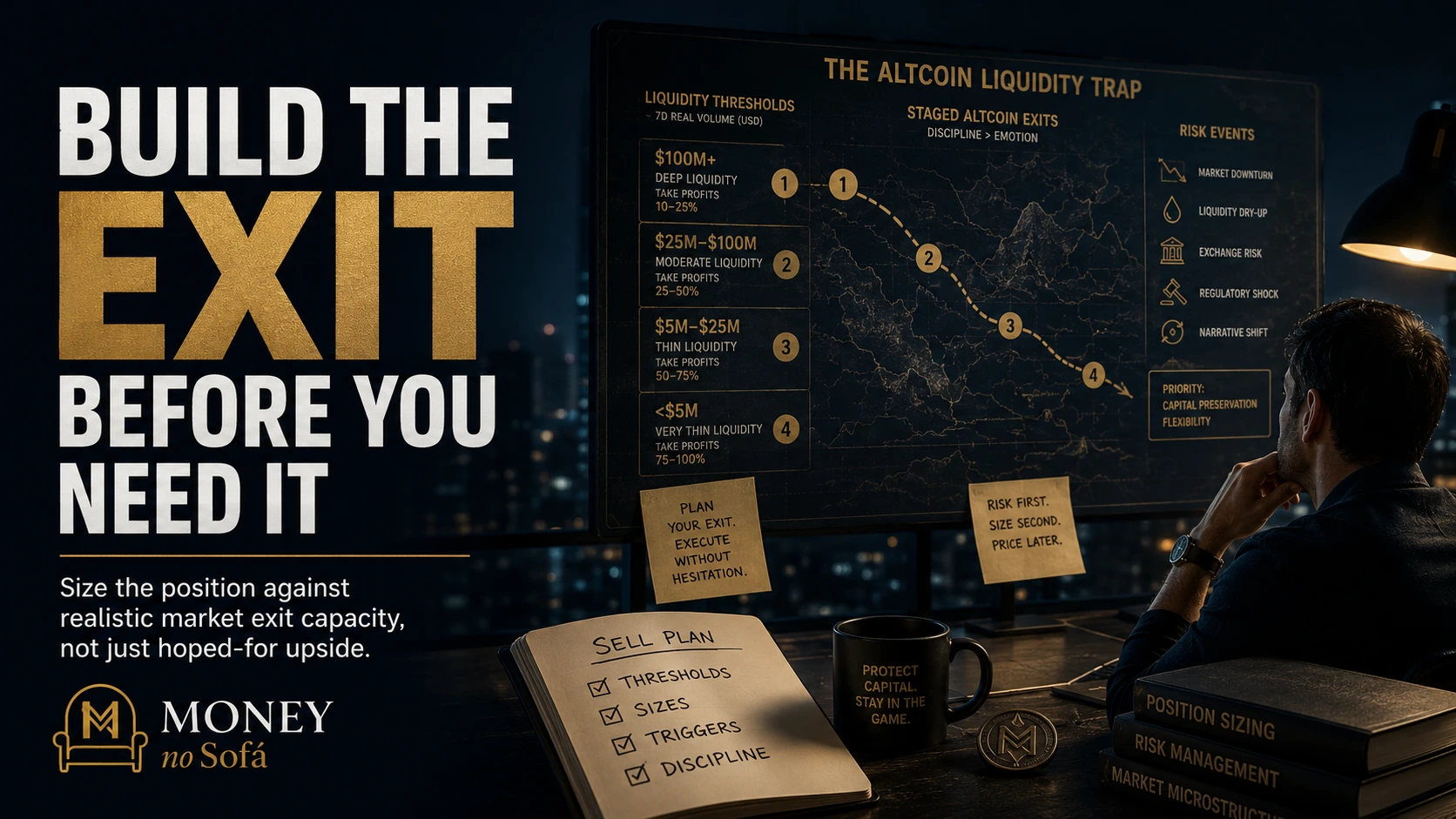
An exit plan begins with position size. Estimate the amount that can be sold within an acceptable slippage range under normal conditions, then reduce that estimate for stress. Your position should not assume that current depth remains available during a broad sell-off.
Define reasons to reduce exposure: deterioration in liquidity, exchange concentration, delayed development, security incidents, governance capture, worsening unlock pressure, loss of a critical market, or a thesis that no longer matches evidence. Price alone is not a complete trigger.
Use staged exits rather than one perfect target. Limit orders can reduce slippage but may not execute. Converting through several pairs can diversify venue risk while increasing operational complexity and fees. Test withdrawals while markets are calm.
Separate long-term conviction from liquidity denial. A project can remain technically interesting while its token becomes difficult to exit. Holding because the market is illiquid is not the same as holding because the thesis is strong.
Document taxes and records. Frequent movement across tokens, stablecoins, and venues can create reporting obligations. The realized outcome is what remains after slippage, fees, spreads, conversion, and tax—not the value shown in a portfolio application.
A practical place to compare the market
Binance can be used as one venue to compare active spot pairs, visible depth, spreads, volume, and withdrawal networks. Check the current regional referral offer with code BITCOIN15, but never treat a listing or promotional benefit as evidence that an asset is suitable.
Check the current Binance referral offer with code BITCOIN15.
Availability, eligibility, fees, products, and referral benefits vary by country and account. Crypto assets are volatile and may result in loss.
A due-diligence scorecard
Score the token across five dimensions. First, market structure: number and quality of venues, spreads, depth, and pair concentration. Second, supply: circulating accuracy, unlock schedule, emissions, and holder concentration. Third, product: users, fees, retention, and token necessity. Fourth, governance and operations: upgrades, treasury, communication, security, and legal exposure. Fifth, exit resilience: withdrawals, self-custody, alternative pairs, and realistic slippage.
Reject false precision. The scorecard does not convert uncertainty into certainty. It makes assumptions visible and prevents a strong narrative from replacing basic market mechanics.
Revisit the score after major unlocks, exchange announcements, protocol incidents, or a change in volume regime. Liquidity is a condition, not a permanent property.
Frequently asked questions
Is market capitalization useless for altcoins?
No. It provides a rough measure of relative scale when circulating supply is credible. It becomes misleading when used without liquidity, concentration, unlocks, and fully diluted valuation.
What is a good volume-to-market-cap ratio?
There is no universal safe ratio. Reported volume quality varies, and one-day data can be distorted. Compare several weeks, credible venues, spreads, depth, and actual trade patterns.
Can limit orders eliminate slippage?
A limit order prevents execution below the chosen price, but it cannot guarantee execution. In a falling or thin market, the order may remain unfilled.
Does a Binance listing make an altcoin safe?
No. A listing provides access and may improve liquidity, but exchanges can review and delist assets. Project, token, custody, and market risks remain.
How should I evaluate token unlocks?
Map the amount, recipients, schedule, and likely incentives. Compare the value of new supply with typical organic spot volume and visible order-book depth.
What is the biggest warning sign?
Dependence on one venue or pair combined with concentrated ownership and large future unlocks creates a particularly fragile market structure.
Liquidity is fragmented across venues and chains
A token can trade on centralized exchanges, decentralized exchanges, regional platforms, and several blockchain networks at the same time. The combined volume may look impressive while each pool remains shallow or operationally isolated. Selling on one venue requires an account and withdrawal access. Selling on a decentralized exchange requires the correct network, gas asset, wallet, and pool. Moving between them introduces time, bridge risk, and price exposure.
Prices can diverge during stress because arbitrage is not frictionless. Deposits or withdrawals may be paused. A bridge may slow. A network may become congested. Market makers may reduce inventory. The highest displayed price may exist on a venue you cannot use or in a pair that cannot be converted efficiently into your operating currency.
Map liquidity by route rather than adding every volume number. Start with the token in your current custody location. Identify the permitted withdrawal networks, the markets available to you, the stablecoin or fiat pairs, and the final path to a bank account or long-term reserve asset. Estimate fees and time for the entire route.
Decentralized liquidity also has special mechanics. Automated market makers price trades against pooled reserves. A trade’s impact depends on pool size and curve design. Concentrated-liquidity positions can make the quoted total value look deeper than the liquidity actually available across a large price move. Aggregators may split an order across pools, but they cannot create reserves that do not exist.
Portfolio diversification can disappear during a liquidity shock
Owning ten altcoins can look diversified when each project belongs to a different category. During a market shock, the assets may behave like one leveraged exposure to crypto liquidity. Correlations rise, stablecoin demand increases, market makers reduce risk, and investors sell the positions that still have bids.
This creates a portfolio-level exit problem. Each position may appear small relative to its individual market, but simultaneous selling across correlated assets can produce larger slippage and operational pressure. Several tokens may depend on the same exchange, stablecoin, bridge, investor group, or market maker. What looks like diversification by ticker can be concentration by infrastructure.
Stress-test the portfolio as a system. Assume daily volume falls sharply, spreads triple, one venue pauses withdrawals, and the primary stablecoin pair trades below its target. Estimate which positions can be reduced, which need an alternative network, and which become effectively locked. Include collateral positions and lending protocols because falling prices can force liquidation at the worst moment.
A liquidity reserve in cash or highly liquid assets reduces the need to sell speculative tokens during stress. It also prevents an illiquid portfolio from determining household or business decisions. Speculation should be funded with capital that does not have a near-term obligation.
How to test liquidity without becoming the market
Start with observation. Record the bid-ask spread at several times of day, visible depth within one and five percent, typical trade sizes, and the share of volume on the largest venue. Compare quiet days with volatile days. A market that looks healthy only during a promotional event is not mature.
Then perform small operational tests. Deposit a modest amount, place a limit order, cancel it, execute a small trade, and withdraw the asset through the intended network. Measure actual fees, delays, support requirements, and the price received. This test is not proof of future liquidity, but it exposes routes that exist only in theory.
For a larger intended position, use a hypothetical liquidation model rather than experimenting with size. Apply increasing slippage assumptions and falling volume. Include the possibility that your own sale attracts other sellers. Public order books are snapshots; large traders may use over-the-counter desks, but those desks also price liquidity and counterparty risk.
Document the result in money, not percentages alone. A five-percent slippage estimate may sound manageable until combined with a twenty-percent market decline, conversion spread, withdrawal fee, and tax obligation. The relevant number is the cash likely to reach the final destination.
The exit is part of the investment
The altcoin liquidity trap begins when investors confuse a quoted price with an executable value. Market capitalization can rank a token. It cannot promise an exit. The real market is the combination of bids, venues, counterparties, supply schedules, market makers, and participant behavior under pressure.
Evaluate liquidity before upside. Examine depth, spread, volume quality, unlocks, concentration, delisting exposure, and withdrawal routes. Size the position for a stressed market rather than the best day on the chart.
A disciplined investor does not ask only how high an altcoin could go. The more important question is how much of the position could be converted, through which route, and under what assumptions when everyone else is asking the same thing.
A practical place to compare the market
Readers comparing crypto markets can use Binance to inspect listed pairs, quoted spreads, visible order-book depth, trading volume, and withdrawal support. A listing is not an endorsement, and exchange liquidity can change quickly.
Check the current Binance referral offer with code BITCOIN15.
Availability, eligibility, fees, products, and referral benefits vary by country and account. Crypto assets are volatile and may result in loss.
Educational notice: This article is general editorial information, not personalized financial, investment, legal, accounting, tax, or security advice. Crypto products, rules, prices, and availability can change rapidly.
Selected sources
Continue Learning About Bitcoin
Liquidity is only one part of platform exposure. Review crypto exchange risks, then use the crypto beginner mistakes checklist before placing a trade.
For a book-length introduction to Bitcoin’s origins, Satoshi and the ideas behind money, explore The Bitcoin Trilogy — Complete Set.
The headline is only the start.
Ask Nova what this story could change in your budget, savings, debt, investments or next purchase.