Spain’s 2–0 win over France became more than a World Cup semi-final. It revealed how wealth, talent, institutions and financial discipline determine who controls the game.
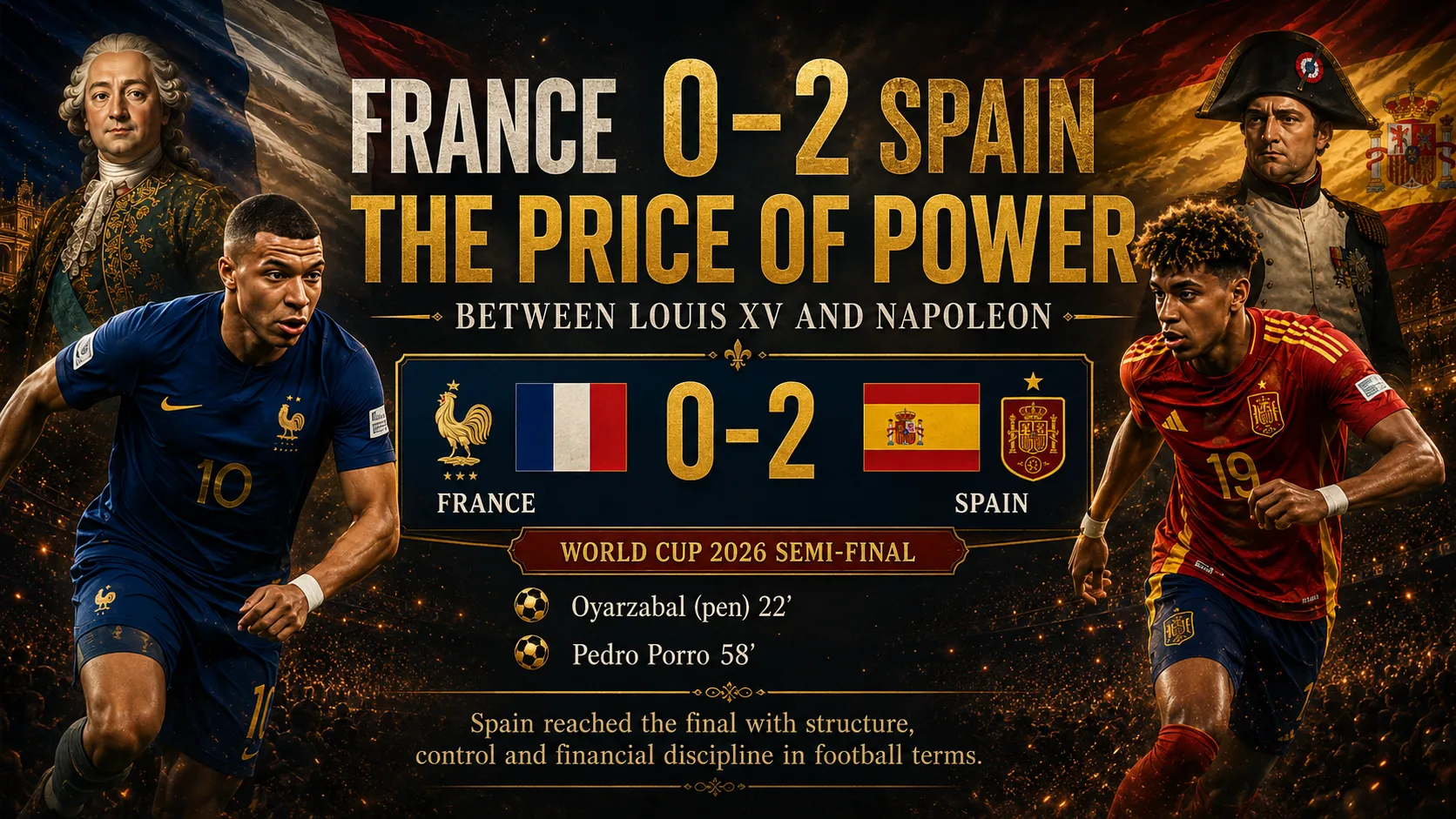
France vs Spain: The Price of Power Between Louis XV and Napoleon
France arrived with some of the most expensive and recognizable attacking talent in world football. Spain arrived with a system that made every player, every pass and every minute serve a shared objective. When the game ended, the scoreboard showed the financial lesson more clearly than any balance sheet could: prestige is not productivity, talent is not cash flow, and wealth without organization can collapse under pressure.
Mikel Oyarzabal opened the scoring from the penalty spot in the 22nd minute after Lamine Yamal drew the foul. Pedro Porro added the second in the 58th minute after combining with Dani Olmo. Spain advanced to the final; France was sent to the third-place match. More importantly, Spain showed how a coordinated institution can outperform a portfolio of glamorous assets.
France Had the Assets. Spain Had the Operating System.
Football is often discussed as if the best collection of players should automatically produce the best team. Finance has a similar illusion: people assume that a high salary automatically creates wealth, a large company automatically creates profit, or a country rich in natural resources automatically creates prosperity.
None of those statements is necessarily true.
An asset only creates value when it is connected to a functioning system. A luxury apartment can become a financial burden if it produces no income and consumes cash. A company can report record sales and still collapse if margins are weak and debt is expensive. A talented employee can underperform when incentives, information and decision rights are badly organized.
France’s attack represented enormous market value. Kylian Mbappé, Ousmane Dembélé, Michael Olise and the other French attackers could decide a match in seconds. But against Spain, the question was not whether France possessed talent. The question was whether the structure could deliver the ball, space and timing required for that talent to produce.
Spain reduced the supply.
Its players compressed the dangerous areas, controlled the tempo and made France’s first pass after recovery more difficult. Each time France regained possession, the opportunity appeared to be temporary. The French players felt pressure to accelerate before Spain reorganized. That urgency created technical errors. Those errors returned possession to Spain. Spain then forced France to run again.
This is how negative compounding works.
One rushed decision creates a turnover. The turnover requires a defensive sprint. The sprint consumes energy. Fatigue reduces precision. Reduced precision creates another turnover. A small operational problem becomes a cycle of declining performance.
Spain produced the opposite cycle. One safe pass created another passing angle. The next pass moved France’s defensive block. That movement opened space elsewhere. The newly opened space increased the value of the following pass. Spain accumulated advantages the way disciplined investors accumulate returns: not through one miraculous transaction, but through many connected decisions.
The First Goal Changed the Price of Risk
Before Oyarzabal’s penalty, both teams could protect their initial plan. After Spain moved ahead, France had to purchase more risk.
That is what happens whenever a person, company or country falls behind its obligations. A household without an emergency reserve may need to use expensive credit after an unexpected expense. A business with weak cash flow may accept unfavorable financing when payroll approaches. A government under market pressure may pay higher interest to attract lenders.
Urgency changes the negotiating position.
Spain’s lead gave it liquidity. It could wait, circulate the ball and choose when to accelerate. France had less time and fewer comfortable choices. The longer Spain held possession, the more expensive the game became for the French.
Liquidity is frequently misunderstood as idle money. In reality, liquidity is stored decision-making power. It allows an investor to wait for a better price, a family to survive a period without income and a company to reject a bad deal. On the pitch, Spain’s control of the ball served the same purpose. Possession gave it time, and time gave it options.
France had to act. Spain could decide.
Why Louis XV Belongs in This Story
Louis XV became king of France in 1715 and ruled until his death in 1774. He inherited one of Europe’s most influential monarchies, a country with population, agricultural production, culture, military power and international prestige. France was not poor in the ordinary sense. Its deeper problem was institutional: the state struggled to transform the wealth of the kingdom into reliable public revenue.
The tax system was complex, unequal and protected by privileges. Powerful groups resisted reforms that threatened exemptions or redistributed the fiscal burden. Wars generated debt, debt generated interest costs, and the political structure made durable reform difficult.
This distinction matters. A country can be wealthy while its government is financially fragile. A family can own a valuable property while lacking enough cash to pay this month’s bills. A company can possess a famous brand while being unable to finance inventory.
Wealth and liquidity are different. Prestige and solvency are different. Potential and execution are different.
The Palace of Versailles describes Louis XV as a monarch who left his successor, Louis XVI, a kingdom that was weakened and divided. That does not make Louis XV the sole cause of the French Revolution, nor does it justify reducing a long reign to a caricature. It does, however, make his era useful as a metaphor for a system that possessed impressive resources but could not mobilize them efficiently enough.
Did Louis XV “Decapitate” France’s Team?
As a headline metaphor, yes—but it requires an immediate historical correction.
Louis XV was not guillotined. He died in 1774. It was his grandson, Louis XVI, who was executed in 1793 during the French Revolution. Saying that “Louis XV decapitated France’s team” should therefore never be presented as a literal historical parallel.
The phrase works only in this sense: the Louis XV model metaphorically cut France off from its own footballing intelligence.
France’s most valuable players became separated from the mechanisms that should have activated them. The attackers were present, but the supply lines were inconsistent. The team had status, but not enough circulation. It had individual power, but insufficient collective leverage.
In that metaphorical sense, France lost its head before it lost the match.
The “decapitation” was not the removal of one player. It was the separation between decision-making and execution, between possession recovery and attacking progression, between the value of the assets and the system designed to monetize them.
This is exactly how organizations fail. They do not always collapse because they lack talented people. They collapse because information does not move, incentives conflict, responsibility is unclear or privileged units are protected from accountability.
Prestige Does Not Pay the Debt
Versailles was one of history’s most powerful machines for producing political imagery. Architecture, ceremonies, clothing, art and ritual communicated authority. The monarchy needed to look permanent, abundant and untouchable.
Modern economies have their own versions of Versailles.
A family purchases a car that signals success but destroys monthly cash flow. A startup rents a spectacular office before building a repeatable revenue engine. A brand spends heavily on celebrity awareness while its sales process remains broken. A creator buys expensive equipment before establishing an audience or distribution channel.
Image is not useless. Reputation can attract customers, talent, partners and capital. But image becomes dangerous when it consumes the resources required to build the underlying capability.
France’s lineup carried immense reputational capital. The names created fear before kickoff. Yet the market value of the squad did not appear as productive output. Spain reduced the space available to France’s stars and forced them into lower-value actions.
That is the financial definition of poor asset utilization.
Concentration Risk: Many Stars, One Dependency
A portfolio can contain several investments and still be dangerously concentrated. Ten technology stocks are not real diversification if all ten respond to the same interest-rate shock. Five clients are not sufficient protection if they all belong to one industry. Multiple income streams are not independent if all depend on the same social platform.
France’s attack contained several elite players, but many of them required similar conditions: open space, rapid transitions, vertical passes and opportunities to isolate defenders.
Spain attacked those conditions rather than attacking each star separately.
By controlling possession and reducing transitions, Spain lowered the number of moments in which French speed could become decisive. By closing central and wide channels quickly, it reduced one-against-one opportunities. By forcing France to build under pressure, it made the first progressive pass more difficult.
The French portfolio had many famous assets, but the returns were correlated. When Spain changed the environment, several assets lost efficiency at the same time.
This is one of the most important financial lessons in the match: diversification is not the number of things you own. Diversification is the number of independent ways you can produce a result.
Spain Controlled the Flow
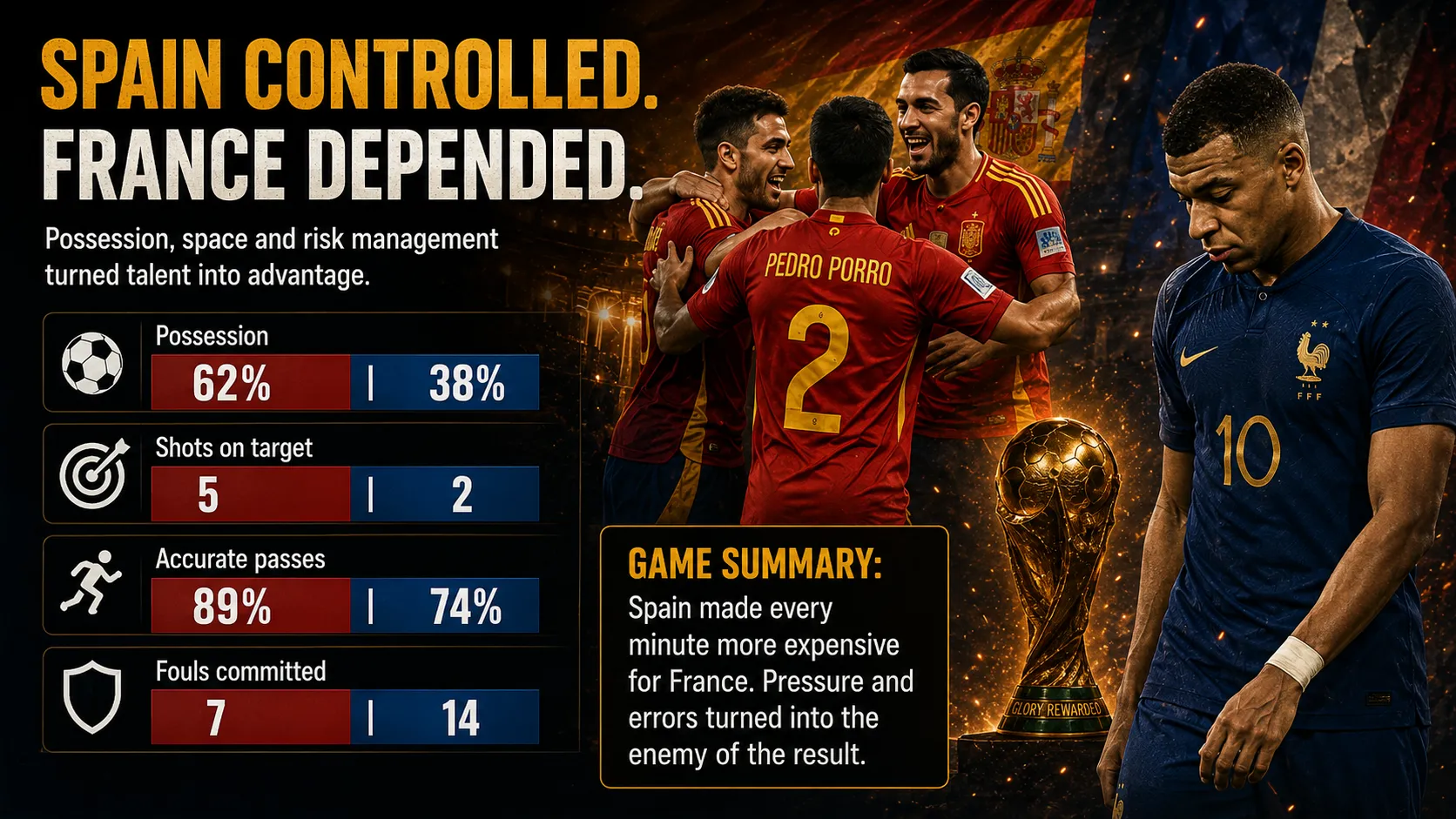
Spain’s greatest achievement was not simply keeping the ball. It controlled the circulation of scarce resources: space, time, attention and energy.
Every football match distributes these resources. Space is limited. Players have limited energy. Attention is divided among the ball, opponents, teammates and tactical instructions. Time disappears continuously.
The team that allocates these resources better usually creates the higher-quality opportunities.
Spain made France spend energy without receiving the ball. It made French attackers move backward to participate. It forced defenders to choose between stepping forward and protecting depth. It made every French mistake feel more costly because recovery required another long defensive phase.
This is the operating logic of a financially strong company. It does not merely increase revenue. It controls working capital, inventory, payment terms, acquisition costs and operational capacity. It understands that every unit of growth consumes resources.
France tried to produce decisive moments. Spain managed the entire production system.
Napoleon Understood That Power Needs Infrastructure
Napoleon Bonaparte is remembered primarily for military campaigns, but his power also depended on financial and administrative reconstruction.
After years of revolutionary instability, France needed greater monetary confidence, more effective taxation and stronger institutions. The Banque de France was created in 1800 under the Consulate, and the monetary reforms associated with the germinal franc helped establish greater stability. Napoleon’s government also strengthened administrative control and tax collection.
The lesson is not that Napoleon created a perfect financial system. He did not. Nor should institutional reform erase the authoritarian nature of his rule. The relevant point is narrower: he understood that ambition without infrastructure is fragile.
An army needs salaries, food, weapons, horses, roads, information, storage and transport. Courage cannot replace logistics. A brilliant general cannot personally carry supplies to every unit.
The same rule applies outside war.
A company needs cash conversion, data, processes, distribution and governance. A household needs budgeting, insurance, savings and rules for debt. A career needs capabilities, relationships, visibility and repeated delivery. Talent creates possibility; infrastructure creates repeatability.
Spain played with Napoleonic organization at its best: coordinated movement, controlled territory, clear roles and reliable supply lines.
Rodri as the Central Bank
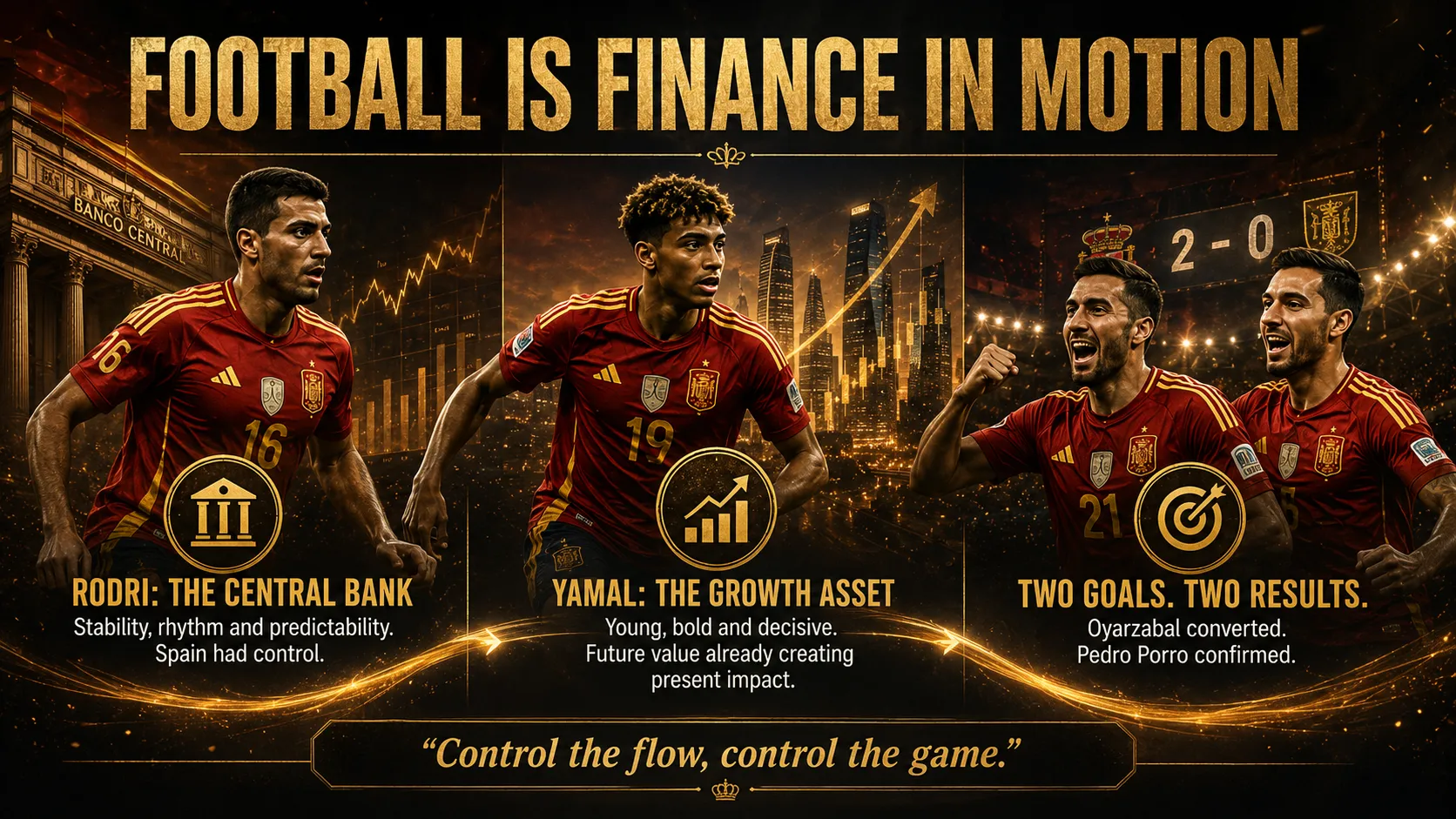
If Spain were an economy, its controlling midfielder would function like a central bank: not responsible for every transaction, but essential to confidence, rhythm and stability.
The best midfield control gives teammates an emergency outlet. When an attack is blocked, the team can recycle possession rather than forcing a low-probability pass. When pressure increases, the midfielder offers a reference point. When the opponent accelerates, the midfield slows the game and restores order.
A credible central bank performs a comparable role. It cannot eliminate every shock, but it influences liquidity, expectations and the conditions under which economic decisions are made.
Spain’s midfield gave the team a form of monetary credibility. Players trusted that possession could be rebuilt. They did not need every attack to succeed immediately. That reduced panic and improved decision quality.
France often appeared to feel the opposite. Because clean attacking moments were rare, each recovery carried too much emotional value. The temptation to force the next action increased. Scarcity created urgency; urgency reduced precision.
Lamine Yamal as a Growth Asset
A mature portfolio needs stability, but stability alone cannot create long-term expansion. It also needs growth assets: investments with uncertainty, energy and the ability to create future value.
Lamine Yamal represented that function for Spain.
His involvement in the penalty showed why growth assets matter. He recognized hesitation, attacked the space and created the event that changed the match. Youth was not treated as a decoration. It was integrated into the operating model.
Companies often praise innovation but isolate young products from the core business. They run pilots that never receive distribution, data or executive sponsorship. Spain did the opposite. Its young talent was connected to the system, supported by experienced players and given decisions that mattered.
Growth became productive because stability surrounded it.
Goals Are Cash Flow
Football produces many attractive intermediate metrics: possession, passes, territory, expected goals, entries into the penalty area and shots. Business produces similar metrics: reach, impressions, website visits, leads, pipeline and engagement.
These indicators matter, but they are not the final economic event.
A goal is the cash receipt of football. It is the moment when potential becomes an irreversible change in the scoreboard.
Oyarzabal converted. Pedro Porro confirmed. Spain’s control became cash flow.
A company can celebrate millions of impressions and still lose money. A salesperson can have dozens of conversations without closing a contract. A household can earn a high salary without building net worth. Activity does not automatically produce accumulation.
The scoreboard forces honesty. So does the bank account.
Napoleon’s Warning: Expansion Has Hidden Costs
Napoleon also provides the warning that prevents this comparison from becoming simplistic praise.
His empire depended on expansion, and expansion created permanent costs. Every new territory required soldiers, supplies, administration and political control. As resistance increased, the marginal return on conquest declined.
The Peninsular War in Spain and Portugal became a severe drain on French manpower, money and attention. What looked like another extension of power became an expensive, prolonged conflict.
This is familiar in modern business.
A company acquires customers through paid advertising. As long as the return is strong, growth looks rational. Then acquisition costs rise, conversion falls and customer service becomes more complex. Revenue continues to increase, but cash generation weakens.
A retailer opens new locations. Sales grow, but inventory, rent, management and logistics grow faster. A creator expands to six platforms, but quality and consistency decline. A family upgrades its lifestyle every time income rises, creating obligations that remove future flexibility.
Expansion creates visible benefits and invisible maintenance.
Napoleon’s failure was not a lack of organization. It was the belief that organization could make unlimited expansion affordable.
France’s football team faced a smaller version of this problem. It had built an attacking identity around speed, verticality and star power. That model had produced victories. But when Spain removed the conditions that generated those returns, France continued to search for the same type of growth rather than quickly creating a different revenue engine.
The Louis XV Problem: Who Pays for the System?
Every organization has costs. The political question is who carries them.
Under the Ancien Régime, privileges and exemptions made fiscal reform difficult. The state needed more reliable revenue, but groups with influence resisted a system that would distribute the burden more broadly. The result was not simply “high spending.” It was a governance problem: responsibilities were not aligned with power.
Companies reproduce this failure when executives preserve their benefits while demanding sacrifice only from operational teams. Families reproduce it when one person controls spending but expects others to absorb the consequences. Football teams reproduce it when some players receive total freedom while the rest of the structure must cover every space they leave.
Freedom is never free. Someone pays for it with distance, energy, time or risk.
A strong system makes that cost visible and distributes it deliberately. A weak system hides the cost until the balance sheet or scoreboard reveals it.
Seven Financial Lessons from France vs Spain
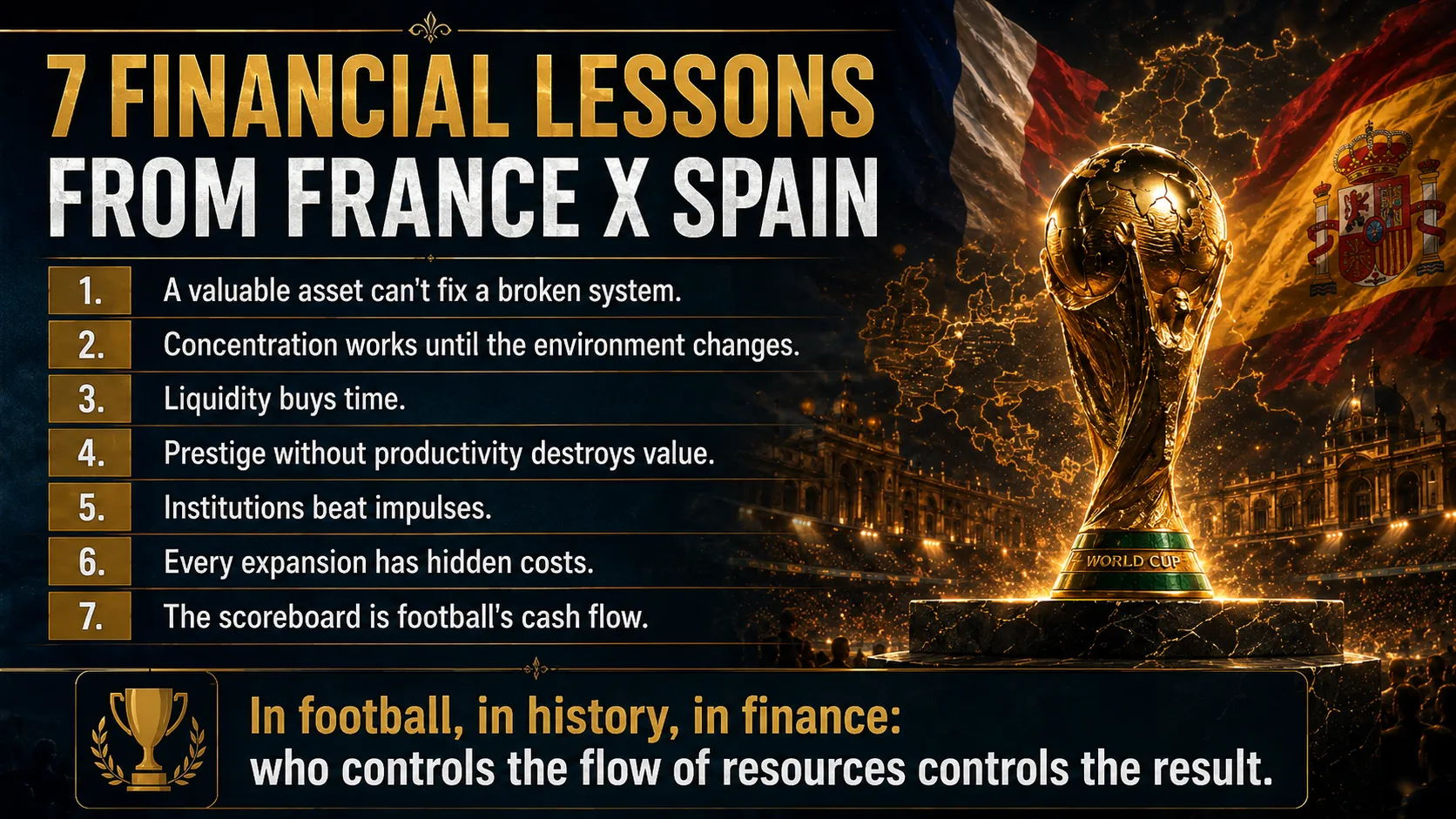
1. A Valuable Asset Cannot Fix a Broken System
Mbappé’s quality did not disappear because France lost. The problem was that the system did not create enough high-value situations for its best asset.
The same applies to property, technology, employees and brands. Buying a premium tool does not repair a bad process. Hiring a famous executive does not replace governance. Earning more money does not fix uncontrolled spending.
2. Concentration Works Until the Environment Changes
France’s attacking strengths were powerful but dependent on similar conditions. When Spain reduced transitions and space, several strengths weakened together.
True diversification means developing independent engines: different customer channels, income sources, products, skills or tactical routes.
3. Liquidity Buys Time
Spain’s control after taking the lead gave it patience. France’s deficit created urgency.
An emergency fund, cash reserve or unused credit capacity is not wasted potential. It is protection against being forced into a bad decision.
4. Prestige Without Productivity Destroys Value
France’s famous lineup did not guarantee output. Versailles-level presentation cannot compensate forever for weak fundamentals.
Status is useful when it reduces acquisition costs, improves trust or creates access. When it becomes an expense disconnected from performance, it destroys value.
5. Institutions Beat Impulses
Spain did not need every player to invent the game again after each pass. Patterns, spacing and shared rules guided decisions.
Automatic investing, written budgets, approval rules, dashboards and operational routines perform the same role. They make good behavior easier when emotion is high.
6. Every Expansion Has Hidden Costs
Napoleon’s campaigns show that growth creates logistics. More territory means more administration. More revenue can mean more inventory, employees, complexity and financing.
The correct question is not “How much can we grow?” It is “What permanent cost structure will this growth create?”
7. The Scoreboard Is Football’s Cash Flow
Possession and activity matter, but goals settle the match. Revenue matters, but cash and profit determine survival. Income matters, but net worth and financial resilience determine whether progress is real.
What France Should Learn
France does not need to abandon star power. It needs to increase the number of structures through which star power can produce.
That could mean better connections between midfield and attack, more coordinated pressure, different occupation of wide spaces or greater patience in possession. The exact tactical answer belongs to coaches and analysts. The strategic principle is broader: a portfolio becomes resilient when it has more than one route to return.
The defeat also closes a major chapter for Didier Deschamps, whose long tenure delivered extraordinary consistency and the 2018 World Cup. One loss should not erase that institutional achievement. In fact, his legacy reinforces the article’s central argument: France became a durable power because it built continuity, discipline and a repeatable competitive culture.
The next French cycle must preserve the institution while expanding the operating system.
What Spain Should Fear
Winning with structure can create its own illusion. A successful system may begin to believe that the system itself is invulnerable.
Spain must remember Napoleon’s second lesson: every advantage creates a temptation to expand it too far. More possession is not automatically better possession. More control can become sterile. Young talent can become overexposed. Tactical confidence can become rigidity.
The final will test whether Spain can preserve discipline while adapting to a different opponent and a different emotional environment.
Institutions create strength, but institutions must also learn.
The Difference Between Rich and Prosperous
France was rich in talent. Spain was prosperous in production.
That distinction reaches far beyond football.
Rich describes what you possess. Prosperous describes what your system can repeatedly produce from what you possess.
A person may be rich in income but poor in time, resilience and savings. A company may be rich in data but poor in insight. A country may be rich in resources but poor in institutions. A team may be rich in stars but poor in coordinated chances.
Prosperity is not an inventory. It is an operating result.
France had the portfolio. Spain had the process. The process reached the final.
Final Thought: Who Controls the Flow Controls the Result
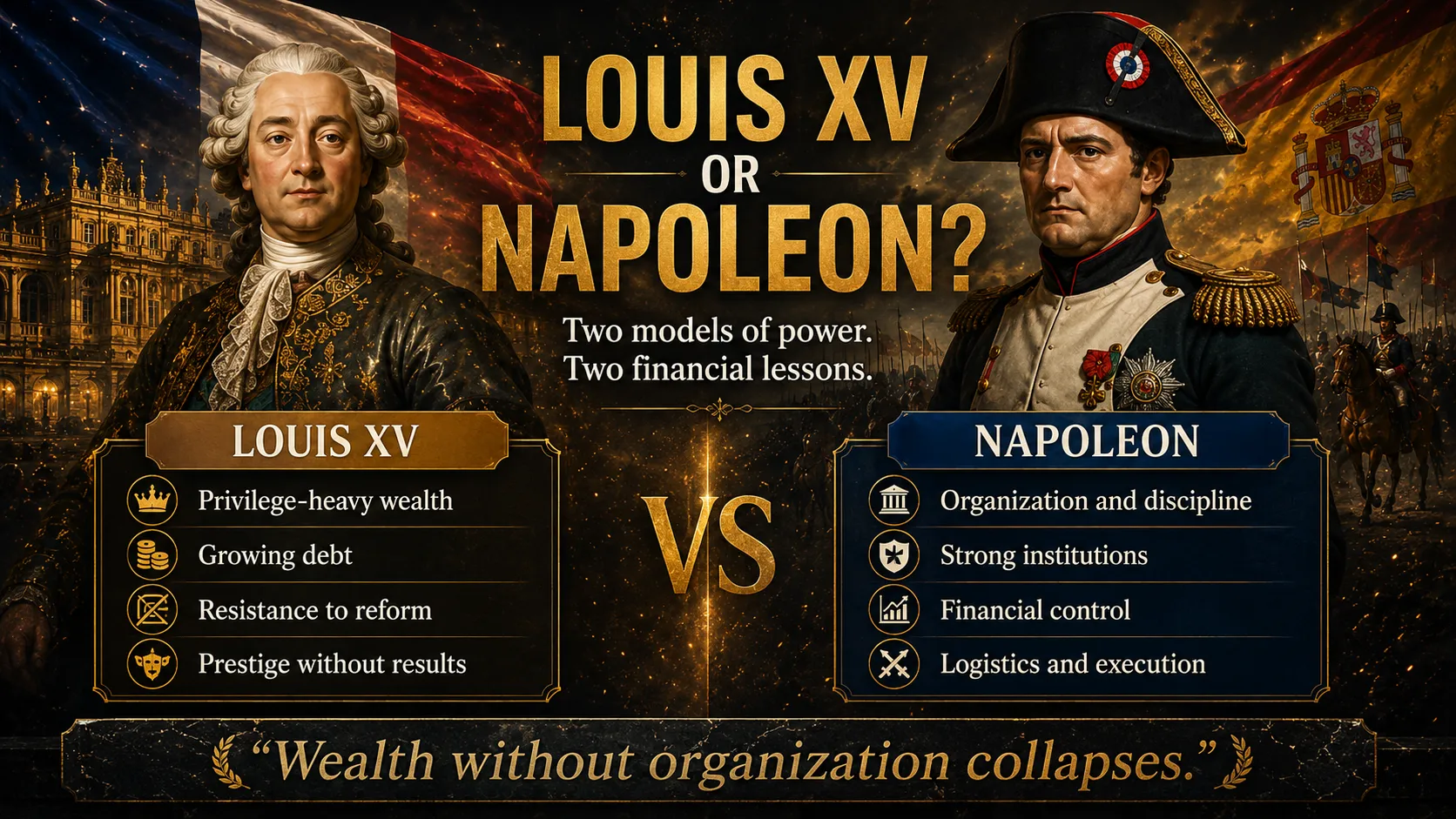
Louis XV represents the danger of wealth trapped inside privilege, debt and resistance to reform. Napoleon represents the power of organization, finance, logistics and institutions—but also the danger of believing that expansion can continue without limits.
France displayed both sides of that history.
It entered with imperial confidence and extraordinary assets. Yet when the system stopped circulating value, the team looked like a wealthy monarchy unable to collect the resources required for action.
Spain behaved like the stronger institution. It controlled the flow of the ball, the price of risk and the timing of decisions. It did not merely defeat France’s players. It made France’s model expensive to operate.
That is why the match belongs on a money site.
In football, history and finance, power does not come only from what you own. It comes from the ability to circulate resources, absorb shocks, assign responsibility and convert opportunity into results.
The final score was 2–0.
The deeper score was system over prestige.
Editorial note: The comparison between France, Louis XV and Napoleon is a narrative framework, not a literal equivalence. Louis XV died in 1774; Louis XVI was guillotined in 1793. The article’s “decapitation” language refers metaphorically to the separation between France’s talent and its operating structure. Visuals are AI-assisted editorial composites. Match statistics can vary according to provider definitions.
Sources and Further Reading
- Associated Press: Spain defeats France 2–0 and reaches the World Cup final
- The Guardian: France 0–2 Spain match report
- Reuters: The end of Didier Deschamps’ era
- Palace of Versailles: Louis XV
- Banque de France: Founding and institutional history
- Napoleon.org: The financial and strategic drain of the Peninsular War
The headline is only the start.
Ask Nova what this story could change in your budget, savings, debt, investments or next purchase.