Learn how to move from hourly freelancing to outcome-focused offers. Scope results, set boundaries, use AI without discounting your value and build fixed-price services.
MONEY NO SOFÁ — MAKE MONEY
If better tools let you finish valuable work faster, billing only for time can turn productivity into a pay cut. The alternative is not vague “value pricing.” It is designing a service around a defined result, fixed scope and visible accountability.
Approx. 17–19-minute read
For decades, professional work has been sold with a familiar equation: hours multiplied by rate. It is simple, easy to explain and often appropriate. It is also increasingly awkward in a world where software, templates, automation and AI can compress work that once required days into hours.
Imagine two consultants who solve the same problem. One has a refined process and finishes in four hours. The other is disorganized and needs twelve. Under pure hourly billing, the slower consultant earns three times as much.
That is not always a problem—some work genuinely requires time, uncertainty and availability—but it reveals the limitation of using labor input as the only measure of economic value.
A client usually cares about a changed state: a cleaner pipeline, a faster reporting process, a stronger landing page, a completed research brief, a working automation, a successful migration, a documented system, a reduced backlog. Time matters because deadlines matter. It is rarely the product itself.
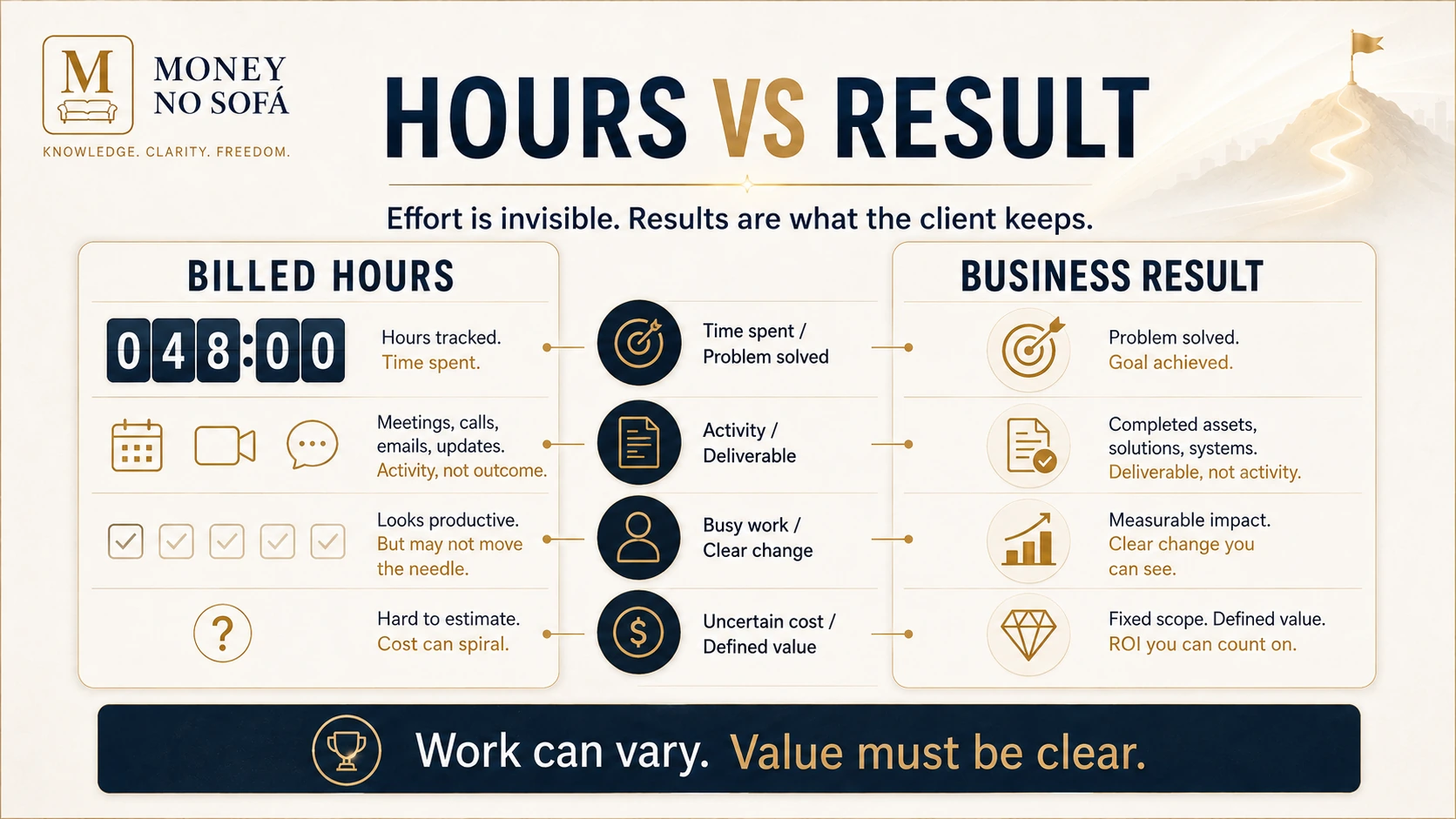
Outcome-based does not mean “charge whatever you want”
The phrase “sell outcomes” is often abused. Some consultants use it to justify arbitrary prices. Others promise financial results they cannot control. A disciplined outcome-focused service does neither.
The model is built on four elements:
- A defined business problem.
- A deliverable or changed state the provider can control.
- A fixed scope with explicit assumptions and boundaries.
- A price agreed before delivery rather than calculated afterward from hours.
The key phrase is what the provider can control. A conversion consultant can promise an audit, implementation and testing system. They cannot honestly guarantee a 40% revenue increase when traffic quality, pricing, inventory and sales execution are outside their control.
Good outcome design creates accountability without pretending to control the universe.
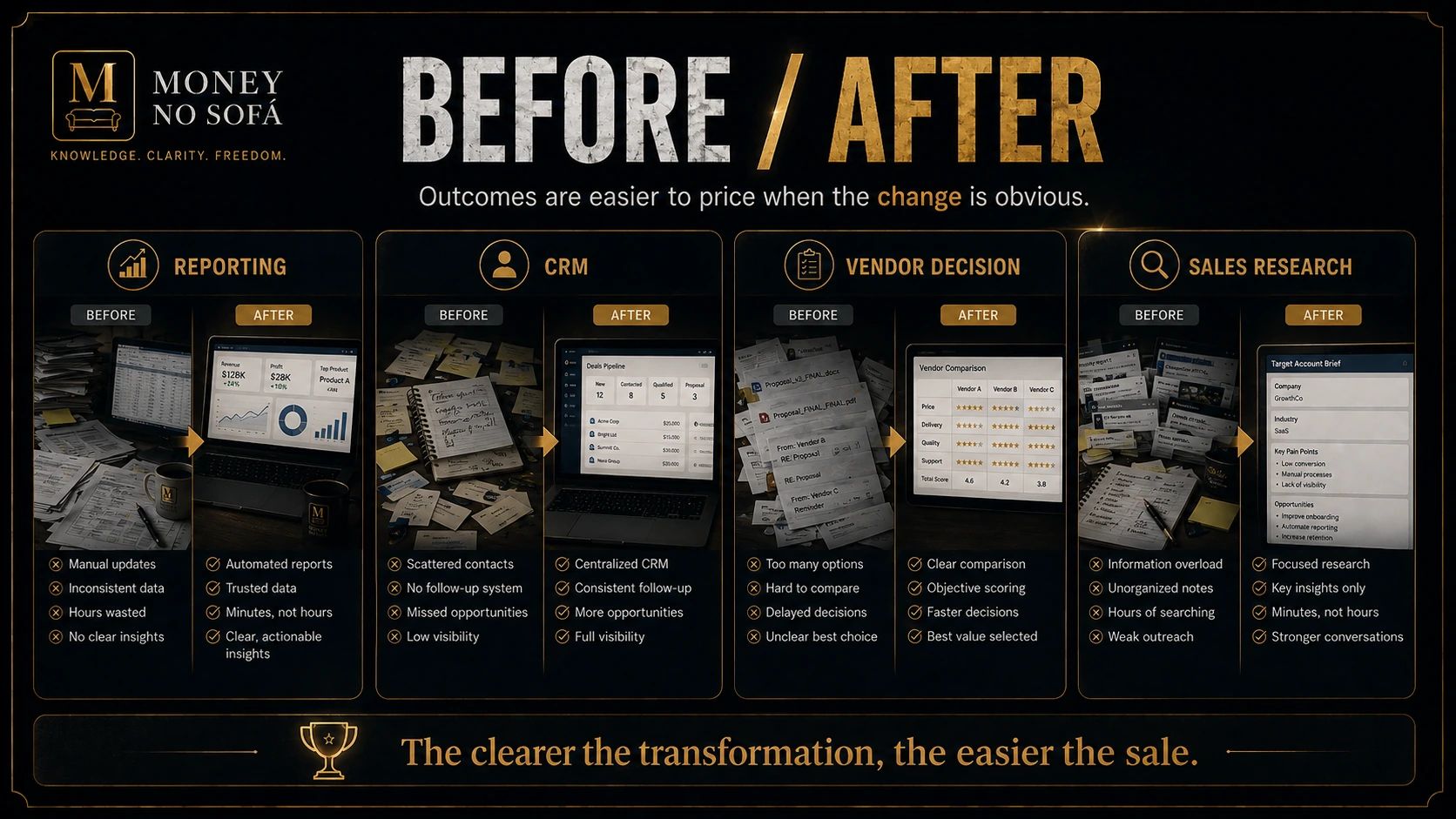
Start with the before-and-after state
Before pricing, write two sentences.
Before: What is true today?
After: What will be true when the project is complete?
Examples:
- Before: weekly reports require six spreadsheets and three hours of manual copying. After: approved source data flows into one standardized dashboard and the team has a documented weekly review process.
- Before: the CRM contains duplicates, stale deals and inconsistent stages. After: records are cleaned according to agreed rules and a maintenance process exists.
- Before: a founder is comparing ten software vendors using scattered notes. After: the five relevant options are scored against agreed criteria with risks and recommendation documented.
- Before: a sales team researches every account from scratch. After: representatives receive a standardized pre-meeting brief with verified sources.
If you cannot describe the after-state clearly, the offer is not ready to price.
Why AI makes this more important
Generative AI is compressing portions of knowledge work. BCG’s 2025 research on GenAI in professional services found specialized tools can deliver meaningful time savings and quality improvements, even while adoption is limited by privacy, customization and training concerns. Upwork’s 2026 skills data similarly shows that AI-enabled skills are growing rapidly while human specialist demand remains strong.
For independent professionals, this creates a strategic choice. You can use AI to produce the same output faster and lower your bill because fewer hours were consumed. Or you can redesign the offer so the client buys the output and the faster process improves your margin.
This does not justify hiding low-quality automation behind a premium fee. Faster is valuable only when quality, accuracy and accountability remain intact.
The economic advantage belongs to the operator who can combine automation with judgment. Use AI to accelerate drafts, classification, analysis, documentation and repetitive execution. Keep human review where mistakes affect customers, money, privacy, compliance or brand reputation.
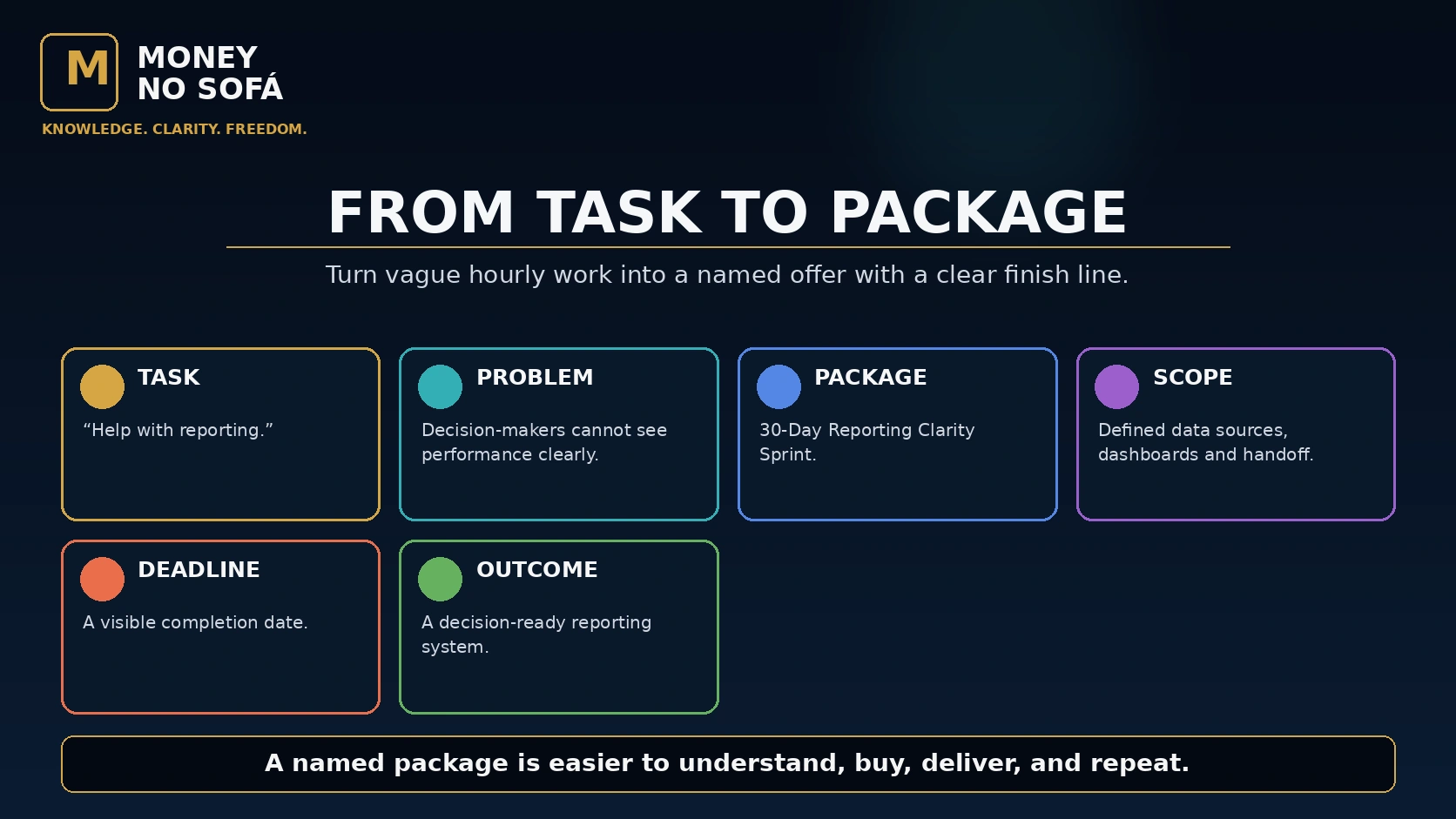
Move from hourly task to fixed-scope offer
Take a service normally described by hours:
Marketing consulting — $100/hour.
Now create a fixed package:
Paid Media Efficiency Sprint — review the last 90 days of one advertising account, analyze campaign structure and wasted-spend patterns, deliver a prioritized action plan, rebuild the negative-keyword framework and conduct one 60-minute decision session within seven business days.
The second offer is easier to evaluate because scope is visible. It also separates the result from the exact number of hours required.
The Scope Box protects the economics
Fixed pricing fails when scope is fuzzy. The antidote is a Scope Box.
Every offer should define:
- Inputs: what the client must provide.
- Units: how many pages, accounts, records, campaigns, locations, interviews or workflows are included.
- Deliverables: exactly what is returned.
- Deadline: when the work will be completed after required inputs arrive.
- Revisions: what changes are included.
- Exclusions: adjacent work that requires a separate scope.
- Client responsibilities: approvals, access and timely feedback.
Without these boundaries, “sell the outcome” becomes “do unlimited work until the client feels happy.” That is not a pricing strategy.
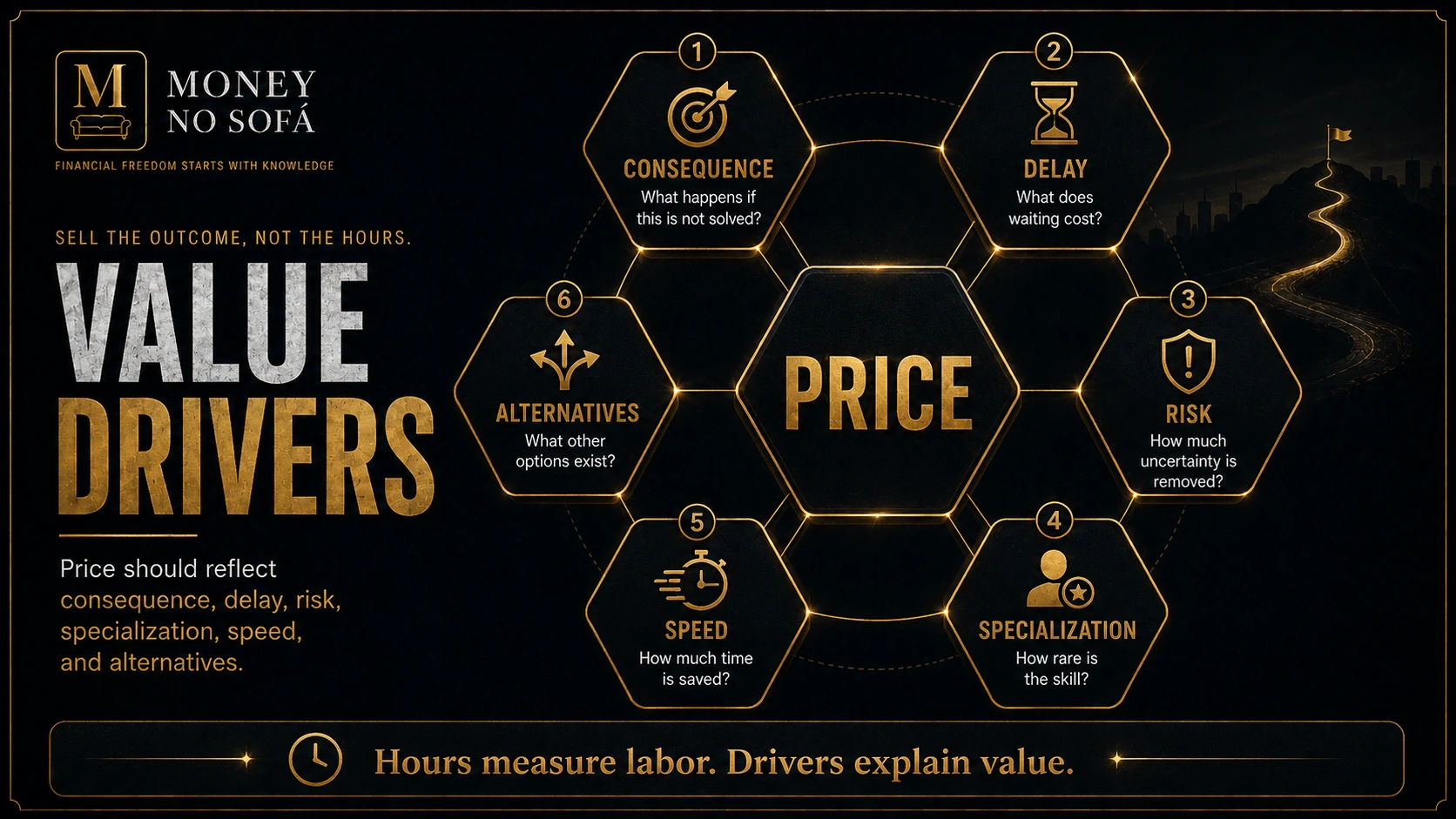
Price against the decision, not your fatigue
Many freelancers estimate price by imagining how painful the work will feel. That is understandable, but incomplete.
A better pricing conversation considers:
- the economic importance of the problem;
- the cost of delay;
- the amount of risk transferred to you;
- the specialization required;
- the speed required;
- the amount of client coordination;
- the alternatives available to the buyer.
A five-page brief can be worth more than a fifty-page report if it supports a large software decision. A two-hour automation can be valuable if it removes ten hours of recurring work every month. A one-day diagnostic can prevent weeks of wasted implementation.
Do not claim imaginary ROI. Connect the price to the business context the buyer already recognizes.
Three pricing models that work together
1. Fixed project
Best when the scope, inputs and deliverables can be defined. Examples: audit, migration, research sprint, setup, redesign or cleanup.
2. Recurring managed outcome
Best when the problem repeats. Examples: weekly lead research, monthly reporting, CRM hygiene, content intelligence, listing maintenance or campaign QA.
3. Day rate or advisory block
Useful when the client truly needs your availability and the problem cannot be fully defined in advance. The client purchases a block of focused access rather than counting every small increment.
Hourly billing still has a place. Emergency troubleshooting, uncertain discovery work, legal work, complex development and open-ended advisory can make time-based billing reasonable. The point is not to eliminate hours. It is to stop using hours automatically when the service can be packaged more clearly.
Create three tiers without inventing useless features
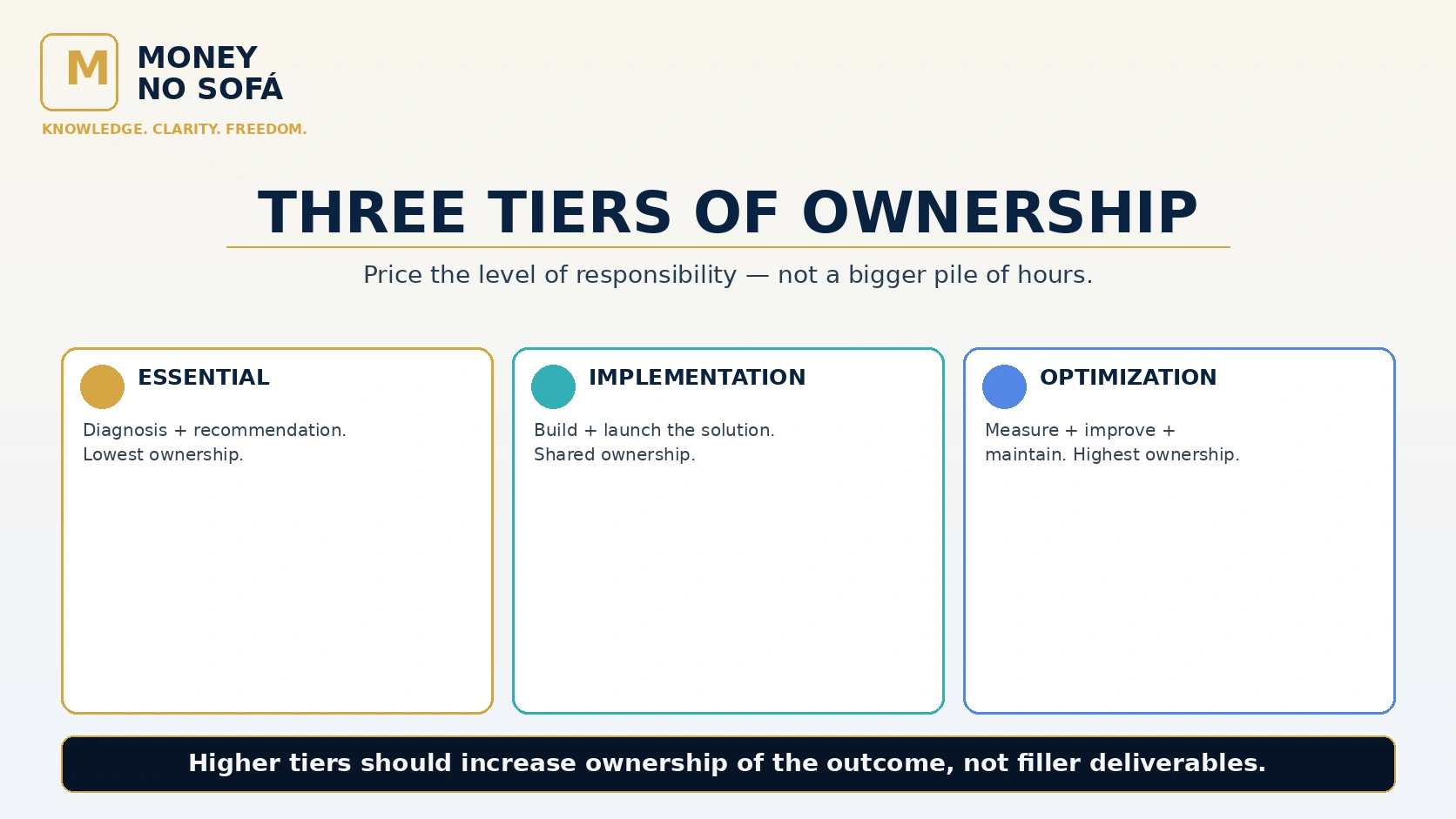
Tiered pricing works when each tier represents a meaningful increase in scope or responsibility.
For a conversion audit:
- Essential — $500: one landing page, annotated audit, prioritized recommendations.
- Implementation — $1,250: audit plus rewritten structure and copy blocks, analytics-event review and one revision.
- Optimization Sprint — $2,500: audit, implementation, measurement plan and two weeks of test monitoring.
Do not create a “Gold” tier that adds decorative PDFs and priority email. The upgrade should solve more of the business problem.
The efficiency dividend belongs to the system builder
Suppose a reporting service originally takes eight hours per client per month. You charge $800. Over time, you create templates, automate data collection and use AI to draft commentary. The same quality now takes three hours.
Under an hourly mindset, you may feel obligated to reduce the price to $300. Under an outcome-focused model, the client still receives the same reliable monthly reporting system. Your process improved. That efficiency is part of the business asset you built.
Competition still matters. If dozens of providers can produce the same output instantly at acceptable quality, market pricing may fall. Value-based thinking does not repeal supply and demand. It simply prevents you from voluntarily charging less because you became more competent.
Use guarantees carefully
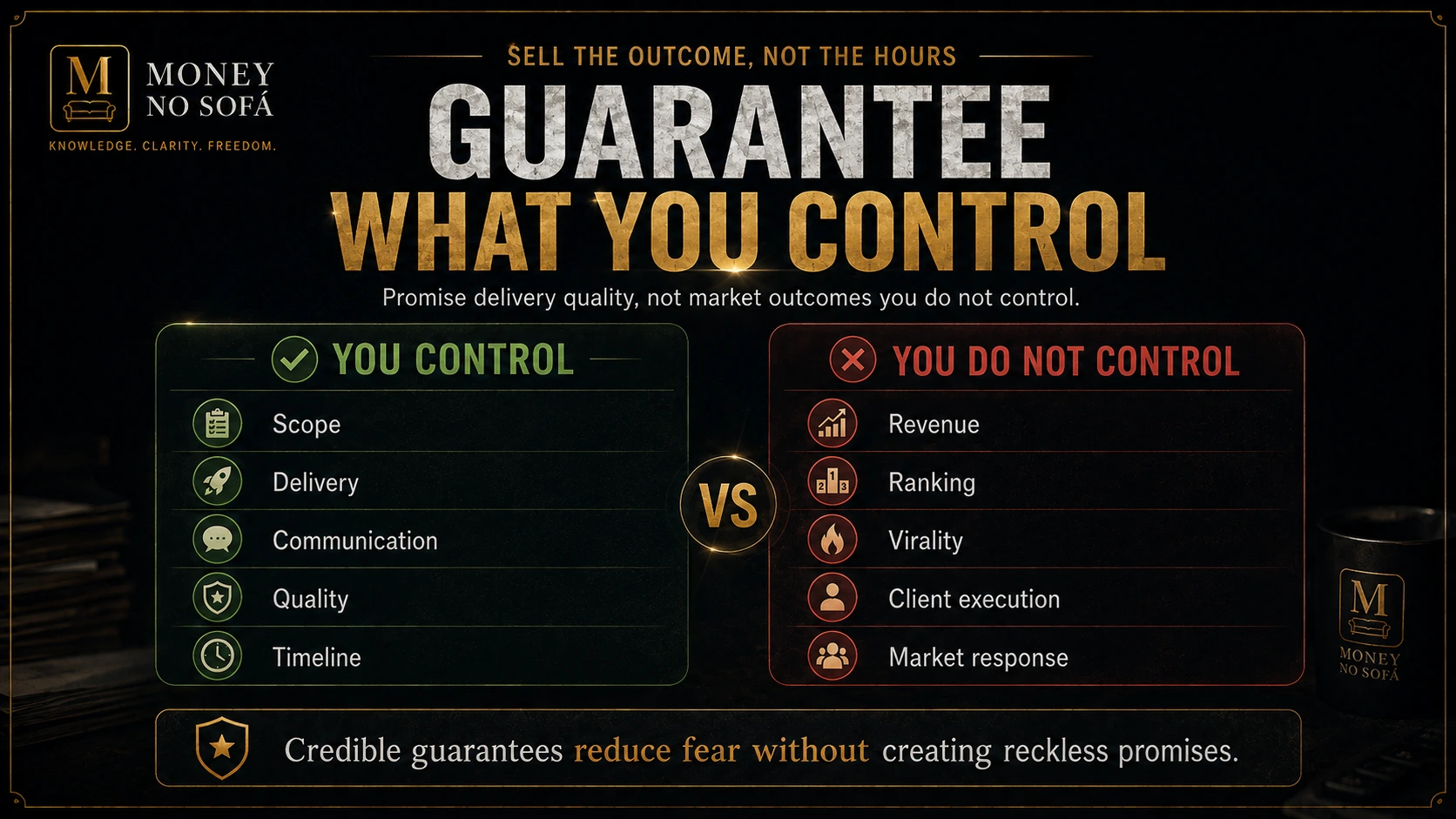
A guarantee can reduce buyer risk, but guarantee what you control.
Reasonable examples:
- delivery by an agreed date if inputs arrive on time;
- a defined number of revisions;
- correction of factual or implementation errors within scope;
- a refund if you fail to deliver the contracted work.
Risky examples include guaranteed revenue, rankings, investment returns, hiring outcomes or conversion lifts you cannot fully control.
Strong positioning does not require reckless promises.
How to explain the price on a sales call
You do not need a philosophical lecture about value pricing. Explain the package.
The project is $1,250. That includes the account audit, the implementation plan, the rebuilt tracking checklist, one working session and one revision. I expect it to take about a week from access to delivery, but the fee is fixed as long as the scope stays inside one account and the agreed date range.
This is transparent. You are not pretending time is irrelevant. You are simply not making the client manage your timesheet.
Track internal hours even when clients do not buy them
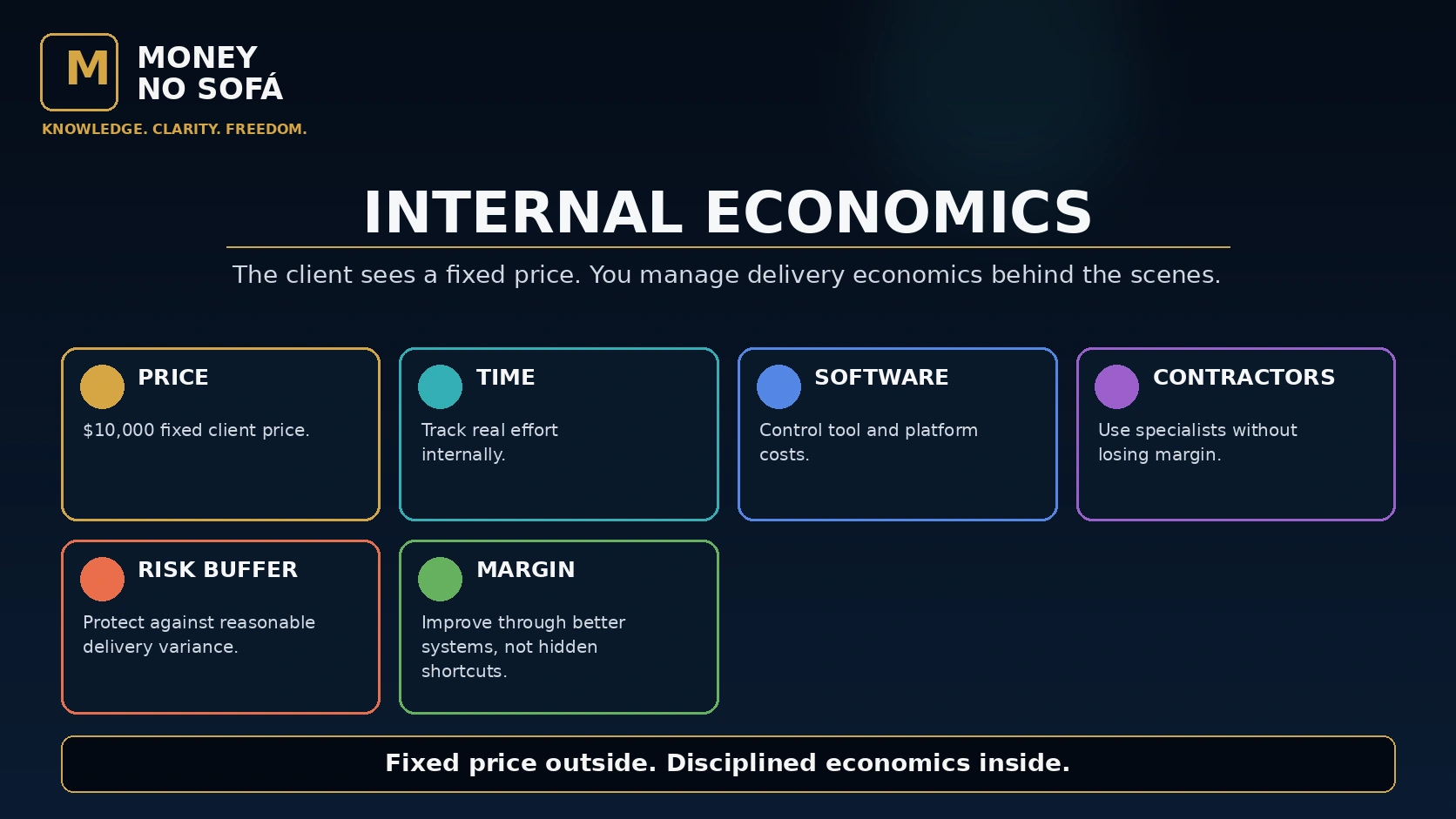
Outcome pricing does not mean ignoring time internally. Your business still has capacity limits.
Track:
- sales time;
- onboarding;
- delivery;
- revision;
- client communication;
- software and contractor costs.
If a $1,000 package consumes 20 hours, expensive software and repeated meetings, the economics may be weak. Internal time tracking shows where the process needs improvement or the price needs adjustment.
The client buys the outcome. You manage the inputs.
Turn expertise into intellectual property
The biggest advantage of fixed-scope services is that repeated work can become a system.
Every project improves your checklist. Every objection improves the offer. Every failure creates a new quality-control step. Every client question improves the onboarding material. Every repeated analysis can become a template or automation.
Eventually, the service contains assets that did not exist when you started: diagnostic frameworks, scoring systems, templates, prompts, standard operating procedures, code, benchmarks and training material.
Those assets improve margin and consistency. They can also support future products, courses, software or licensing. The transition from freelancer to business begins when knowledge stops living only in your head.
Know when hourly is still the honest model
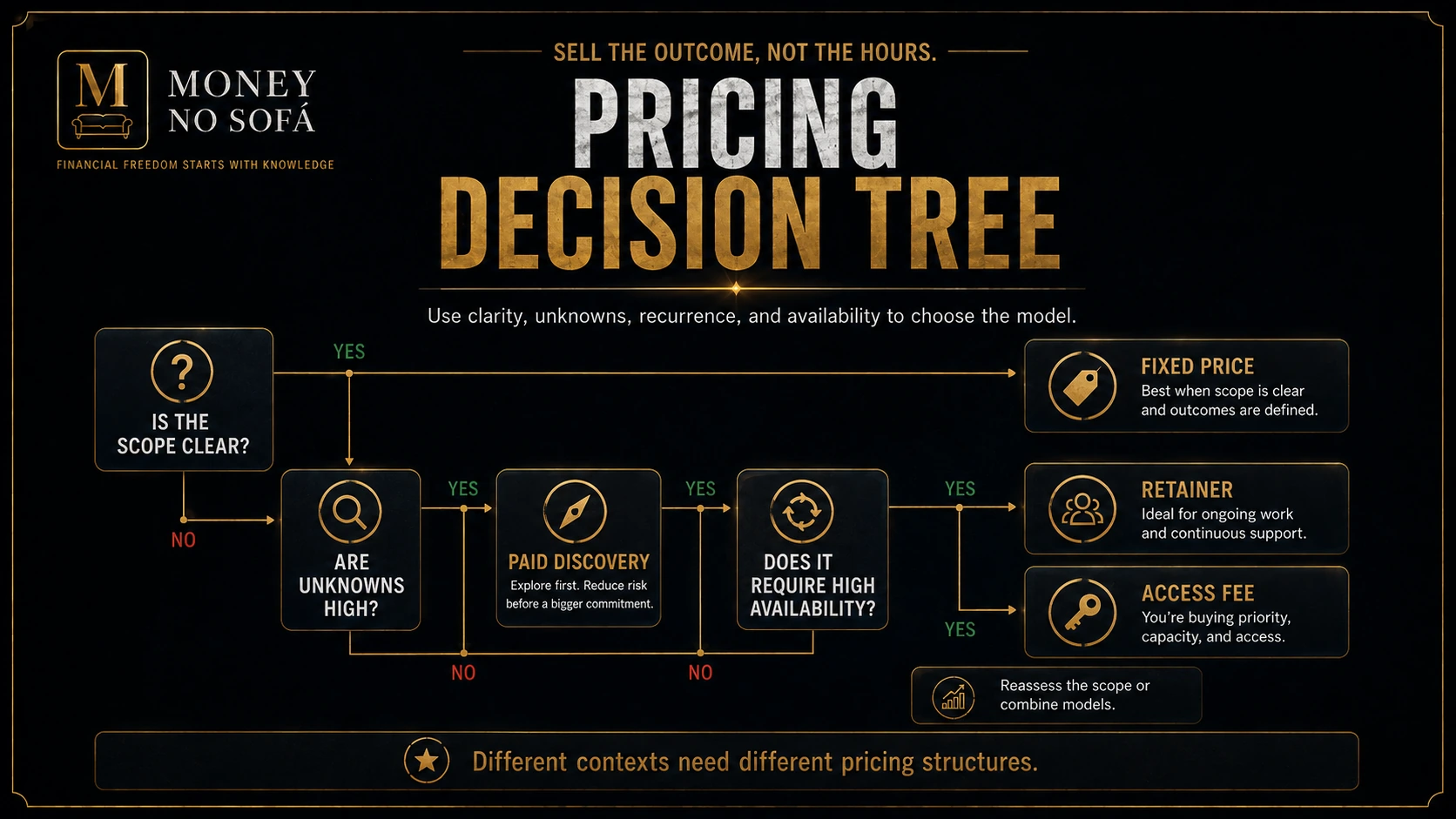
Some projects cannot be responsibly scoped. Legacy-system debugging may reveal unknown problems. Executive advisory may involve unpredictable questions. Incident response may require open-ended availability. Early discovery may exist specifically to determine what the project should be.
In these cases, hourly or day-rate billing can be cleaner. You can also use a paid discovery phase before proposing a fixed implementation.
Good pricing matches uncertainty. The mistake is not hourly billing. The mistake is using one model for every kind of work.
A 30-day transition plan
Week 1: Review your last five projects. Identify the recurring before-and-after states.
Week 2: Choose one service that can be defined by units, deliverables and deadline. Build a Scope Box.
Week 3: Create a fixed price using your historical internal hours, market context and the business value of the problem. Test it with prospects.
Week 4: Deliver the package, track actual internal time and record every scope exception. Use the data to improve version two.
Do not convert your entire business overnight. Productize one repeatable service first.
The deeper shift
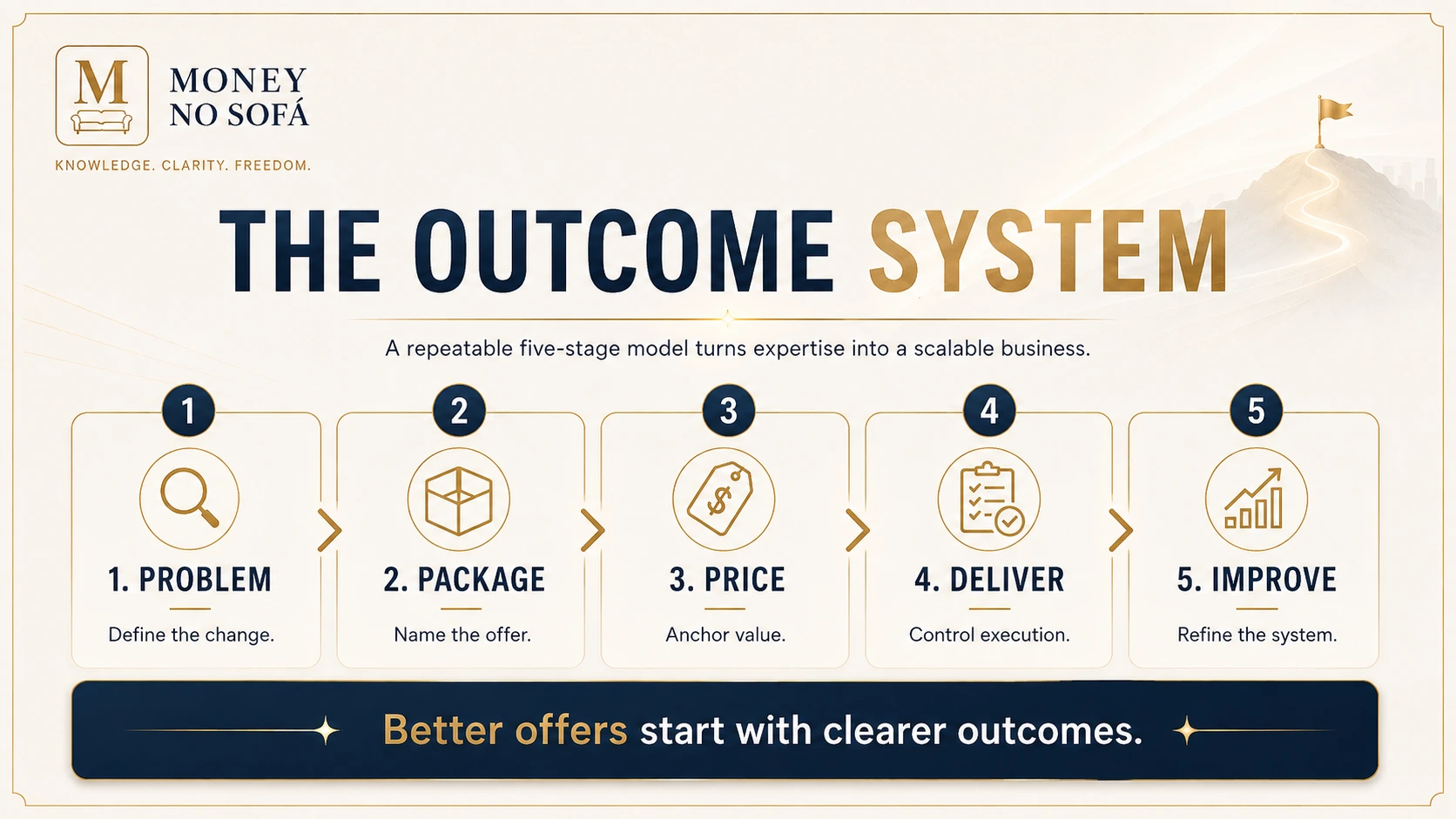
Selling hours encourages the professional to ask, “How long will this take me?” Selling outcomes encourages a better first question: “What must be true for the client to consider this solved?”
That shift improves positioning, scope, delivery and automation. It also makes AI easier to integrate ethically because the tool is judged by whether it helps produce the contracted result at the required quality—not by whether it makes the timesheet shorter.
Your time will always matter. It is finite. That is exactly why it should not be the only thing you know how to sell.
Use paid discovery when the outcome is still unclear
Sometimes the client knows something is wrong but neither side knows the correct solution. Trying to force a fixed implementation price at this stage creates risk because the unknowns are the project.
Sell discovery separately. A paid diagnostic can include stakeholder interviews, data review, process mapping, technical assessment and a recommendation. The outcome of discovery is clarity: a defined problem, options, risks and an implementation scope.
This protects both sides. The client is not committing to a large project before understanding it. You are not guessing a fixed fee while hidden complexity remains. If implementation follows, the discovery work becomes the foundation of the proposal.
Paid discovery is especially useful for migrations, automation, analytics, operations and technical consulting where the visible symptom may have several causes.
Change orders are not conflict; they are scope hygiene
Fixed pricing works only if both sides can distinguish a new request from the original promise. A client may reasonably discover new needs during the project. The professional response is not resentment and not free expansion. It is a simple change process.
When a request falls outside scope, explain the difference, estimate the additional work and offer a separate fee or future phase. Keep the tone neutral: “That is useful, but it sits outside the current one-account audit. I can add the second account for $350 and extend delivery by two days, or we can schedule it as phase two.”
Clear change orders actually protect trust because the client always knows what is included and why the price changed. Scope ambiguity is more damaging than a professional boundary.
Outcome pricing improves hiring economics too
A documented package makes delegation easier. If the service is sold as “ten hours of my time,” handing part of the work to a trained analyst can feel like a downgrade to the client. If the service is sold as a defined system with quality standards and your final accountability, a team can deliver portions of the workflow without changing the promised result.
This is how a solo service becomes a business. You keep the design, judgment and quality control while documented tasks move to employees, contractors or automation. Margin is then created by process, not by squeezing more billable hours into your week.
Use a minimum profitable price, not just a market price
Before quoting externally, know the lowest price at which the package still makes business sense. Estimate realistic delivery time, sales and onboarding effort, software, contractor costs, payment fees, revision risk and the profit margin required to keep the service healthy.
This calculation prevents a common mistake: creating an attractive fixed package that quietly pays less than a weak hourly rate once hidden work is counted. Outcome pricing is not permission to ignore cost. It is a way to separate customer value from your internal production model while still protecting the economics.
Make the payment path as clear as the scope
For international clients, Wise is one option to compare for receiving and moving money across currencies. Include processing fees and settlement timing in your internal margin calculation.
Current fees, eligibility, settlement terms and services vary by account and region. Money no Sofá may receive compensation from eligible referrals.
If the market will not support a profitable price, change something structural. Narrow the scope, specialize in a higher-value niche, automate a repeatable step, remove unnecessary meetings, improve qualification or stop selling that package. The answer is not always to work faster.
A healthy service needs both sides of the equation: the buyer must feel the outcome is worth the fee, and the provider must be able to deliver it repeatedly without turning every sale into overtime.
The proposal should read like an operating agreement, not a brochure
Once a prospect is interested, the proposal should remove ambiguity. Keep the sales language short and make the operating details easy to inspect.
A practical fixed-scope proposal can include the current problem, desired after-state, included work, excluded work, client inputs, timeline, deliverables, revision policy, price, payment schedule, confidentiality terms and what happens if assumptions change.
For larger projects, add acceptance criteria. If you are building a dashboard, define which data sources and views must work. If you are cleaning a CRM, define how duplicates and stale records will be handled. If you are delivering research, define the number of competitors, markets or sources covered.
Acceptance criteria reduce subjective disputes. “Make it better” is impossible to finish. “Deliver one dashboard using the three agreed data sources with the five approved metrics and a documented refresh process” can be accepted.
A clear proposal also makes price feel more rational because the buyer can see what responsibility is being transferred. The document is not there to impress the client with adjectives. It is there to make the agreement difficult to misunderstand.
Another useful discipline is to review every completed package against the original Scope Box. Which assumptions were wrong? Which client inputs arrived late? Which revision request repeated? Which step could be automated? That post-project review is how fixed pricing becomes more accurate over time instead of remaining a guess.
Your first move
Take one service you currently describe by the hour. Write the before-state, after-state, included units, deliverables, deadline, revisions and exclusions. Then quote the next qualified prospect a fixed price and track your internal economics privately.
Frequently asked questions
Is outcome pricing the same as value-based pricing?
They overlap, but this approach emphasizes concrete scope and a provider-controlled result rather than an abstract percentage of perceived value.
Should I tell the client how many hours I expect?
You can if it helps transparency, but make clear that the agreed fee covers the defined scope rather than an exact number of hours.
What if the project takes longer than expected?
If the scope did not change, that is usually your estimating risk. Track it and improve pricing. If the client expands the scope, use a change order or separate proposal.
Does AI mean I should lower my prices?
Not automatically. If AI reduces cost while maintaining quality, it can improve margin. Market competition, quality and buyer alternatives still influence pricing.
Can recurring services be outcome-based?
Yes. Define the recurring controlled state and cadence—for example a clean CRM every week or a monthly competitor intelligence brief.
Selected sources
- Boston Consulting Group — GenAI Tools in Professional Services, April 2025.
- Upwork — In-Demand Skills 2026, on AI-enabled skills and continued demand for human specialist expertise.
- Upwork — In-Demand Skills 2025, on specialization, automation and skills-based freelance demand.
- Upwork — Future Workforce Index 2026, on judgment-driven skilled freelance work.
Editorial note: Pricing examples are illustrative. Contracts, taxes, professional obligations and consumer-protection rules vary by jurisdiction and industry.
The headline is only the start.
Ask Nova what this story could change in your budget, savings, debt, investments or next purchase.