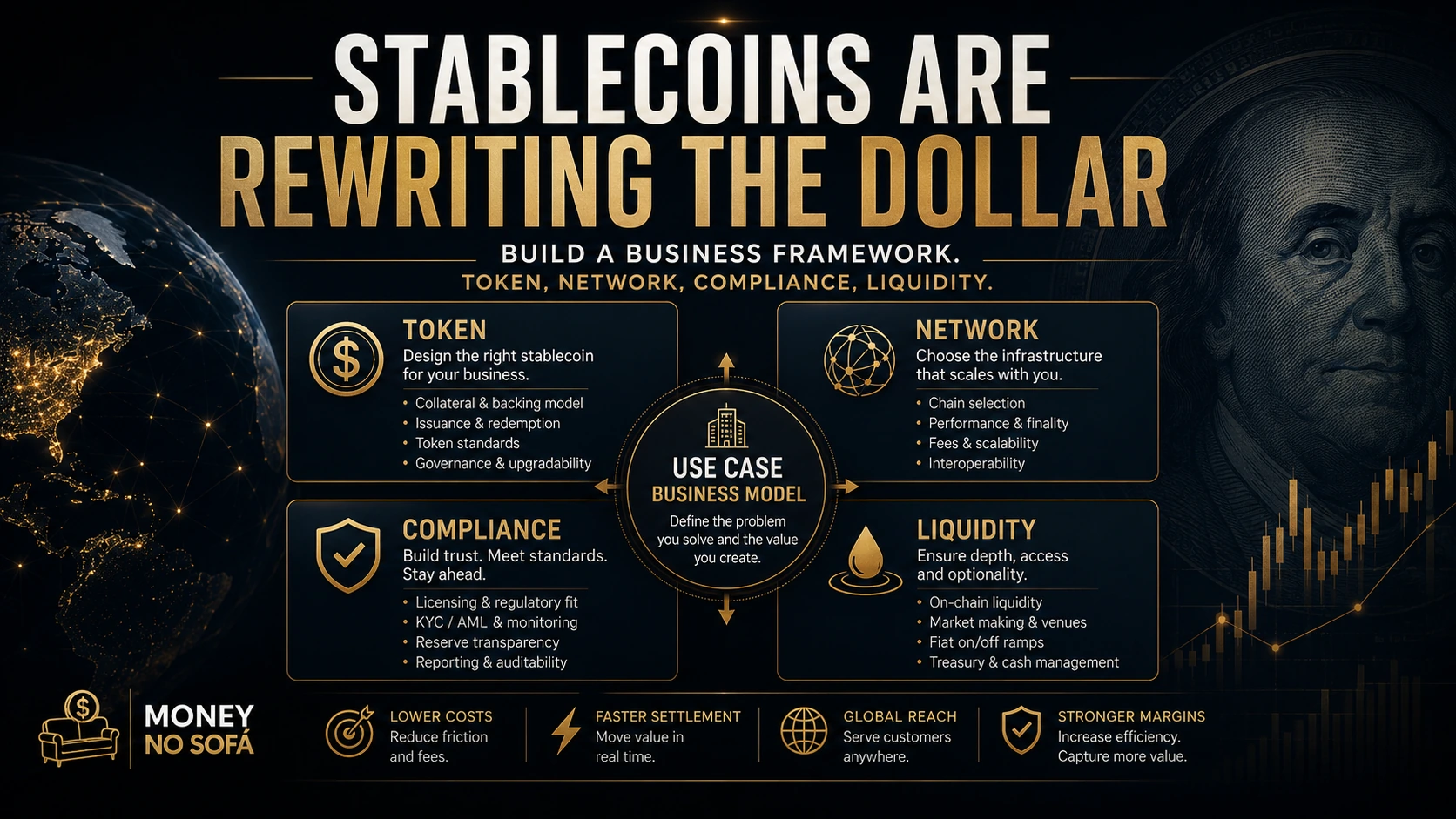
Canada enacted a Stablecoin Act in 2026, but implementation timing still matters. Here is what businesses should understand before changing payment workflows.
Disclosure: This article is educational and does not constitute legal, tax or investment advice. Money no Sofá may earn from qualifying partner links where clearly disclosed.
Canada’s stablecoin conversation changed in 2026. What used to sound like a crypto-policy debate is becoming a payments-infrastructure question. For businesses, however, the headline needs an important footnote: having a federal legal framework and having every operational rule fully live are not the same thing.
- Canada now has a federal stablecoin framework, but implementation timing still matters.
- The best business use cases remain selective: cross-border payments, contractor payouts and digital services.
- Settlement speed is only valuable if custody, compliance and accounting also work.
- Pilot one corridor before changing a core payment stack.
The headline needs a footnote
Canada now has federal legislation addressing fiat-backed stablecoins, with a framework built around issues such as reserves, redemption, governance, security and supervision. But legislation can contain provisions whose practical effect depends on coming-into-force dates, regulations and supervisory implementation.
That distinction matters because a merchant can read “Canada regulates stablecoins” and assume the operational uncertainty has disappeared. It has not. Businesses still need to verify the current status of the issuer, service provider, applicable rules and their own obligations before moving meaningful money.
Why this matters for small businesses
The business case for stablecoins is not ideological. It is operational. International invoices, contractor payouts, digital services and certain treasury movements can create friction through foreign-exchange spreads, bank cut-off times, wire fees and settlement delays.
A stablecoin can potentially improve one of those corridors, but only if the entire process is better. Transaction speed alone is not enough. The business must include conversion costs, compliance, support, custody and accounting in the comparison.
The opportunity remains real
Cross-border payments are the most intuitive place to test the technology. A business that regularly receives or sends international payments can compare its existing route against a stablecoin-enabled provider.
The relevant calculation is total operational cost: payment fees, FX spread, settlement time, failed-payment rate, staff time, network fees, conversion costs and reconciliation. Faster access to cash can itself have economic value, even when the headline fee difference is small.
Stablecoins are not bank deposits by default
A token designed to track the Canadian or U.S. dollar should not automatically be treated as equivalent to money in an insured bank account. The legal structure, reserve arrangement, redemption rights, custody model and provider relationship all matter.
Businesses should understand exactly what they own, who owes the redemption obligation, where assets are held and what happens if an intermediary becomes unavailable.
Use a provider checklist
Before adopting a service, ask: Who issues the stablecoin? Who custodies funds? Which networks are supported? How does redemption work? What compliance checks apply? How are refunds handled? Can transaction data be exported into accounting software? What happens if a transfer is sent to the wrong address or network?
If the provider cannot answer these questions clearly, do not move meaningful business funds through it.
Accounting is the real integration
A blockchain confirmation is not the end of a business payment. The invoice, token amount, exchange rate, network fee, transaction identifier, settlement value, timestamp and counterparty record must reconcile.
A new payment rail that saves a fee but creates hours of month-end cleanup is not cheaper. Finance operations should be part of the pilot from day one.
Pilot, do not migrate
Choose one payment corridor and a small group of trusted counterparties. Put a dollar cap on the experiment. If holding stablecoins is not part of the treasury strategy, consider automatic conversion into fiat through an eligible provider. Start with low-value transactions and keep the existing payment method available.
Measure total cost, settlement time, reconciliation time, support burden and failure rate. Expand only after multiple clean cycles.
The right way to think about 2026
The important development is not that stablecoins suddenly became risk-free. It is that they are moving closer to normal financial infrastructure. That makes disciplined experimentation more reasonable—and careless experimentation less defensible.
For a normal business, the winning stablecoin implementation should be boring: narrow, compliant, measurable, recoverable and clearly better at one specific job.
FAQ: stablecoins for Canadian businesses
Does Canada’s stablecoin law mean every stablecoin is approved?
No. A federal framework does not make every token, issuer or service provider equivalent. Businesses still need to verify current legal status, provider eligibility and operational rules.
What is the best first use case for a small business?
A narrow, high-friction corridor such as an international invoice or contractor payment is usually easier to evaluate than replacing all card or banking flows.
Should a business hold stablecoins on its balance sheet?
That is a separate treasury decision. A company can test stablecoin payment infrastructure while using automatic conversion to fiat instead of intentionally holding token exposure.
Stablecoins for Normal Businesses
A plain-English guide to payments, settlement, custody and operational risk — built for businesses that want a useful framework, not crypto theater.
Next step: Verify current legal and provider status in your jurisdiction before changing an existing payment workflow.
The headline is only the start.
Ask Nova what this story could change in your budget, savings, debt, investments or next purchase.