Your first business AI agent should be narrow, measurable, permissioned, and recoverable. This practical guide shows how to build controlled autonomy that earns trust.
MONEY NO SOFÁ — PREMIUM EDITORIAL
The safest first AI agent is not a digital employee with unlimited authority. It is a narrow operating system with explicit permissions, measurable outputs, human checkpoints, and a recovery path.
Approx. 18-minute read
AI agents are being sold as the next leap in business productivity: software that does not merely answer a question, but decides what to do next, chooses tools, takes action, and continues until the job is finished. The promise is real. A well-designed agent can reduce waiting, copying, sorting, formatting, routing, and follow-up across an entire workflow. But the same ability that creates leverage also creates a new category of operational risk. When an ordinary automation fails, it usually stops. When an agent fails, it may continue confidently.
That difference changes how a small business should start. The goal of a first agent should not be maximum autonomy. It should be maximum learnability. You need a system whose behavior can be observed, measured, challenged, and improved. A narrow agent that saves forty minutes a day and produces a clean audit trail is more valuable than a spectacular demo that can send the wrong email, publish the wrong price, or overwrite the wrong customer record.
This article lays out a practical operating model for building that first agent. It is not a manifesto against autonomy. It is a sequence for earning autonomy.
The autonomy trap
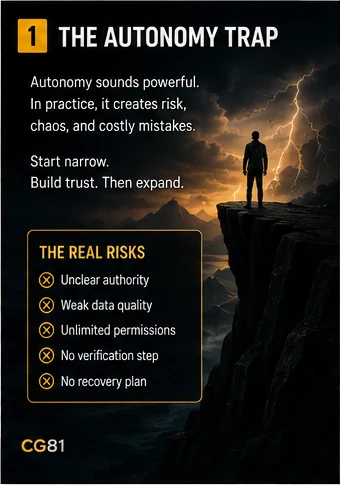
The autonomy trap begins with an attractive sentence: “Handle this for me.” The instruction sounds efficient, but it hides dozens of decisions. Which sources may the system trust? Which customer records can it read? Can it send a message without approval? Can it spend money? What happens when the source data conflicts? What happens when a tool times out after partially completing the task? What happens when the model chooses a reasonable action that violates a company policy nobody documented?
Human employees resolve many of these ambiguities through context, memory, hierarchy, and social judgment. An agent does not automatically inherit that institutional knowledge. It sees the instructions, tools, data, and state you expose. If those boundaries are vague, the system will fill the gaps probabilistically. That can look intelligent right up to the moment it becomes expensive.
The common mistake is to evaluate an agent by the quality of its best run. Business reliability is defined by the distribution of runs: normal cases, edge cases, missing fields, stale data, malicious inputs, duplicate requests, permission errors, and partial failures. A first agent should therefore be designed around the question, “How will we know when this is wrong?” before the question, “How much can this do?”
OpenAI’s Agents SDK now includes tool approvals and human-in-the-loop interruption patterns for sensitive actions, as well as input and output guardrails around function tools. Those capabilities reflect a broader engineering reality: reliable agent systems are not a single prompt. They are controlled workflows with explicit boundaries.
Start with one contract
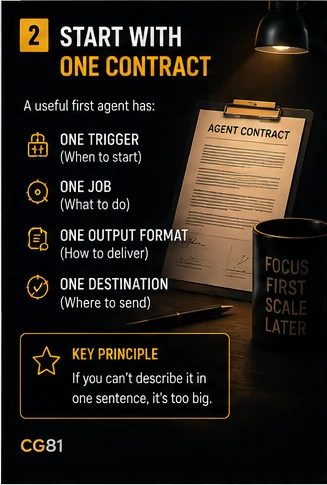
Your first agent needs a contract. Not a legal contract, but an operational one. It should define the trigger, inputs, allowed sources, task, output schema, destination, success criteria, escalation conditions, and recovery behavior.
Consider two instructions:
- Vague: “Grow our website with AI.”
- Operational: “Every weekday at 8:00 a.m., collect Search Console queries with at least 100 impressions and an average position between 5 and 20, group them by topic, identify five content gaps, and save a structured brief in Google Drive for editorial approval.”
The second instruction can be tested. It has a schedule, a defined data source, thresholds, a transformation, an output count, a file destination, and an approval boundary. You can compare the agent’s recommendations with a human editor’s judgment. You can measure how many briefs are accepted, edited, or rejected. You can improve one step without rebuilding the whole system.
A strong contract also states what the agent must not do. It may not publish. It may not change a URL. It may not delete a record. It may not invent a source. It may not proceed when required data is absent. Negative constraints are not pessimism; they are part of the product specification.
For a small business, the best first-agent contracts usually involve high-frequency, reversible, low-permission work: classifying leads, drafting a response, summarizing reports, creating content briefs, reconciling structured fields, detecting exceptions, or preparing a next-action queue. These jobs produce value without immediately placing money, reputation, or customer rights at risk.
Use the six-verb workflow
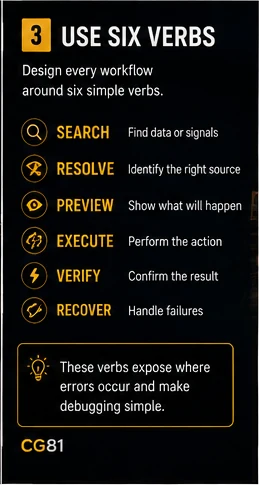
A practical agent can be designed around six verbs: search, resolve, preview, execute, verify, and recover.
1. Search
The system gathers candidates from approved sources. This may be a database query, a Drive folder, an inbox search, an API response, or a list of WordPress drafts. Search should be broad enough to find the work, but constrained enough to avoid unrelated data.
2. Resolve
The agent identifies the correct entity. Which customer is this? Which product? Which post? Which invoice? Resolution is where many silent mistakes begin. Names are duplicated. Email addresses change. Slugs are similar. The agent should use stable identifiers whenever possible and stop when confidence is too low.
3. Preview
Before any consequential action, create a structured preview. Show the recipient, action, source, changed fields, old value, new value, and reason. A preview turns a hidden model decision into a reviewable business object.
4. Execute
Only approved actions move forward. Execution should be idempotent where possible, meaning that repeating the same request does not create duplicate charges, duplicate emails, or duplicate posts. Every write action should produce a transaction ID, content ID, or tool response that can be logged.
5. Verify
Do not assume a successful API response means the business result happened. Re-read the record. Check the published URL. Confirm the attachment exists. Validate the final amount. Verification closes the gap between “the tool ran” and “the outcome is correct.”
6. Recover
Recovery defines what happens after failure. Can the action be retried safely? Should it be rolled back? Does a person receive an alert? Is the item moved to an error queue? A workflow without recovery is a demo, not an operating system.
This sequence can be implemented in n8n, a custom application, or an agent framework. The specific software matters less than preserving the control points.
Permissions are strategy
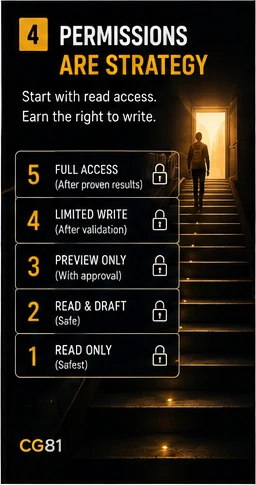
Permissions determine the economic shape of an agent. Read access creates insight. Write access creates leverage and liability. The first version should normally be allowed to read more systems than it can change.
A useful permission ladder looks like this:
- Read: inspect approved data sources.
- Classify: label, prioritize, and route items.
- Draft: prepare content or proposed changes.
- Recommend: present a decision with evidence.
- Write reversible changes: update a draft, add a tag, create a task.
- Write consequential changes: publish, send, refund, buy, delete, or change price.
Movement up the ladder should depend on evidence. After twenty successful draft runs, the agent might be allowed to create tasks automatically. After fifty successful reconciliations with no material errors, it might update a low-risk field. Publishing, payments, refunds, account access, and legal communication should remain approval-gated until the organization has mature monitoring and a clear reason to remove the checkpoint.
The principle is simple: permissions are not a convenience setting. They are a capital-allocation decision. Every permission should produce enough measurable value to justify its failure mode.
NIST’s AI Risk Management Framework emphasizes governance, measurement, mapping, and management across the AI lifecycle. For a small business, that can be translated into four practical questions: Who owns the workflow? What can it affect? How do we measure performance? What happens when it is wrong?
The business case: automate waiting, not judgment
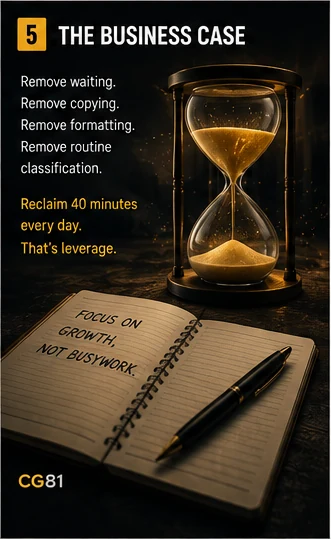
Many businesses overestimate the value of replacing judgment and underestimate the value of removing latency. A process can take three days even when the actual work requires twenty minutes because it waits in inboxes, changes formats, crosses departments, and depends on somebody remembering the next step.
An agent can compress those gaps. It can collect the inputs before the meeting, detect missing fields, prepare the comparison, route the exception, and remind the responsible person. That does not eliminate human judgment. It makes judgment arrive with better information and less administrative friction.
To build the business case, measure five quantities:
- Frequency: how often the task occurs.
- Handling time: active human minutes per occurrence.
- Waiting time: elapsed time between steps.
- Error cost: rework, refunds, missed revenue, or reputational damage.
- Control cost: review, monitoring, and maintenance required after automation.
A task that takes ten minutes but happens eighty times a week may be more valuable than a two-hour task that happens once a month. A task with frequent missing data may be worth automating even if the agent never completes it, because it can detect and route exceptions instantly.
Do not calculate return using only wages saved. Include faster response time, higher follow-through, cleaner data, fewer forgotten opportunities, and better visibility. Also include the cost of supervision. If a person must inspect every output line by line, you have built a drafting assistant, not an autonomous agent. That may still be valuable, but the economics are different.
Metrics that prevent self-deception
Agent demos are persuasive because they compress the story into one successful run. Operations require a scoreboard. Use metrics that expose both value and risk:
- completion rate;
- human approval rate;
- edit distance between draft and approved output;
- exception rate;
- false-positive and false-negative rates;
- time saved per run;
- cost per successful outcome;
- duplicate-action rate;
- recovery success rate;
- material incident count.
Set an error budget before expanding permissions. For example, the agent may be allowed to auto-tag leads if the monthly misclassification rate remains below 2% and no high-value lead is routed incorrectly. If performance falls outside the budget, the workflow returns to approval mode.
Track changes by version. A prompt edit, model change, new tool, or modified data source can alter behavior. Without versioning, you cannot tell whether performance improved or simply changed.
Build this week
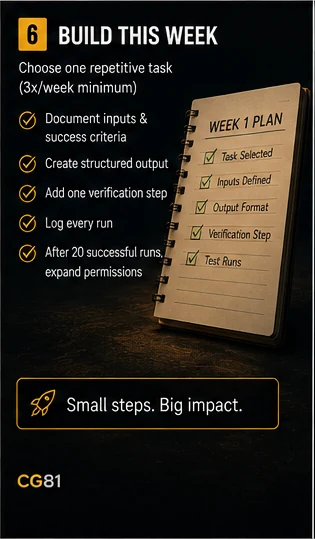
Here is a practical seven-day build sequence:
- Day 1 — Choose the task. Select a repetitive job that occurs at least three times per week, has structured inputs, and does not require irreversible authority.
- Day 2 — Write the contract. Define trigger, sources, schema, destination, success criteria, forbidden actions, and escalation rules.
- Day 3 — Build the read path. Connect the source systems and log the raw inputs. Do not add write permissions yet.
- Day 4 — Produce structured drafts. Require JSON or another strict schema before rendering emails, pages, or reports.
- Day 5 — Add preview and approval. Create a human-readable summary of the proposed action.
- Day 6 — Add verification and recovery. Re-read the destination after execution and route failures to an error queue.
- Day 7 — Run a controlled pilot. Process real but low-risk work. Compare with the old process and record every correction.
The first version should feel almost disappointingly narrow. That is a strength. Narrow systems reveal where the actual complexity lives.
Example: a content-brief agent
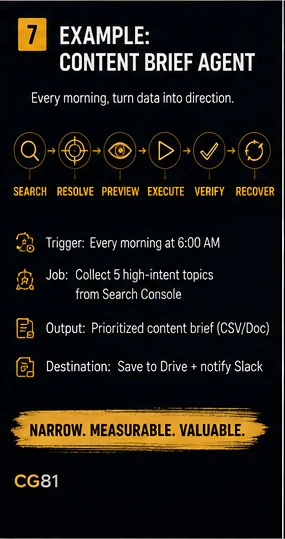
A strong first use case for a publisher is a content-brief agent. It can read Search Console, analytics, the existing article library, and a keyword source. It can identify queries where the site has visibility but weak coverage, cluster related questions, detect cannibalization, and prepare a brief.
The contract might require:
- one primary query and five supporting questions;
- the current ranking pages and their gaps;
- the proposed thesis, not merely a title;
- search intent and commercial intent;
- original evidence the article must contain;
- internal-link targets;
- one subtle affiliate opportunity that is useful to the reader;
- an image plan with one cover and nine internal visuals;
- a minimum target of seventeen minutes of substantive reading.
The agent saves research and formatting time, but an editor still decides whether the thesis deserves publication. This is exactly the kind of boundary a first system should preserve.
Tools worth evaluating
A practical stack usually includes a workflow orchestrator, a model provider, structured storage, monitoring, and a human approval surface. Compare tools on reliability, logging, permission controls, portability, and total operating cost—not only on the quality of a demo.
Explore the Money no Sofá eBook library and implementation resources.
Verification and recovery are the product
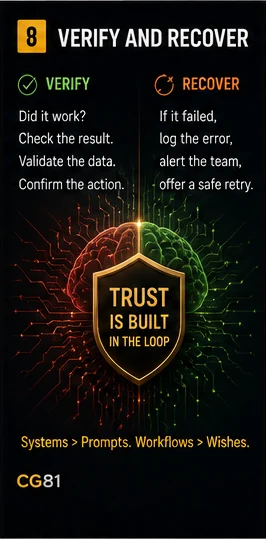
Most agent failures are not dramatic. They are quiet: the wrong version is attached, the correct post is updated with an outdated excerpt, a customer receives a duplicated message, or a task is marked complete before the external system finishes processing.
Verification should be independent of the model’s confidence. If the agent uploads ten images, count the media records. If it publishes a page, fetch the public URL and confirm the title, status, canonical URL, and expected links. If it updates a price, read the price from the system of record after the write.
Recovery should separate transient failures from logical failures. A timeout may be retried. A missing customer ID should be escalated. A policy conflict should stop the workflow. A partially completed multi-step action may require compensation, such as deleting a draft that was created before a later step failed.
Keep a dead-letter queue for items that cannot be completed safely. Every entry should contain the original input, current state, failed step, error message, run version, and recommended next action. This transforms failure from a mystery into a manageable workload.
When autonomy becomes reasonable
Autonomy should increase when the workflow demonstrates four properties:
- Stable inputs: the source data is consistent and well identified.
- Bounded actions: the agent cannot affect unrelated systems or records.
- Observable outcomes: success and failure are measurable.
- Recoverable errors: mistakes can be reversed or contained.
Even then, autonomy may be conditional. Routine cases can execute automatically while exceptions require approval. Low-value transactions can proceed while high-value ones pause. Known recipients can receive messages while new recipients require review. This is not a compromise. It is how mature automation separates predictable work from judgment.
A 30-day operating playbook

Days 1–7: build the narrow workflow and run it in shadow mode. The agent proposes actions while the old process remains authoritative.
Days 8–14: compare outputs, record corrections, and classify failure types. Improve data quality and rules before changing the model.
Days 15–21: allow reversible write actions for low-risk cases. Require approval for communication, publication, pricing, refunds, and deletion.
Days 22–30: review the scorecard. Expand one permission only if the workflow remains inside its error budget and the additional autonomy creates clear value.
At the end of the month, you should have more than an agent. You should have an operational asset: documented, measurable, versioned, and connected to a real business result.
A safer architecture: planner, executor, verifier
Do not ask one model call to interpret the goal, choose the action, execute it, and declare success. Separate the responsibilities. A planner proposes the steps and structured intent. An executor performs only approved tool calls. A verifier inspects the result against objective rules. These roles can use the same underlying model, but they should not share unchecked authority.
The planner should produce a machine-readable plan: target record, proposed change, reason, evidence, required permission, and expected outcome. The executor should reject any field outside the approved schema. The verifier should use system data rather than the executor’s narrative. If the executor says a page was published, the verifier fetches the page. If it says ten images were uploaded, the verifier counts media records and checks file types.
This separation reduces a subtle failure mode: self-confirmation. A system that performs an action and then evaluates itself from the same conversational context is biased toward believing the task succeeded. Independent verification introduces friction, but it is productive friction.
Data quality comes before model quality
Many disappointing agent projects are diagnosed as model failures when the real problem is inconsistent data. Customer names differ across systems. Product codes are missing. Documents have no version labels. Folder names are ambiguous. Status fields mean different things to different teams.
Before improving prompts, improve identifiers and schemas. Use a stable customer ID, post ID, order ID, or file ID. Define required fields. Store timestamps and source references. Separate raw input from normalized data. Make the agent report uncertainty instead of forcing a guess.
A better model can make a more persuasive guess. It cannot turn an ambiguous record into a safe business action.
Prompt injection and untrusted content
An agent that reads email, web pages, documents, support tickets, or uploaded files is exposed to untrusted instructions. A malicious or accidental sentence inside a source can tell the agent to ignore its rules, reveal information, or call a tool. The content may look like ordinary business data while functioning as an attack on the workflow.
Treat external text as data, not authority. Keep system instructions separate. Limit the tools available in each step. Validate tool arguments. Do not let a document decide which records the agent may access. Require approval for sensitive actions even when the model claims urgency. Log the source that influenced each action.
For retrieval workflows, provide only the minimum relevant content rather than an entire mailbox or drive. The security boundary is strongest when the agent never receives data it does not need.
An n8n implementation pattern
A controlled first-agent workflow in n8n can follow this sequence:
- Trigger: schedule, webhook, Drive folder, form, or inbox event.
- Normalize: convert the input into a strict internal schema.
- Resolve: search the system of record and require a unique ID.
- Model step: request a structured recommendation, not a free-form action.
- Validation: reject missing fields, unexpected values, or forbidden operations.
- Risk switch: route low-risk drafts forward and sensitive actions to approval.
- Execute: call the smallest necessary tool.
- Verify: read the destination and compare it with expected state.
- Log: store run ID, inputs, version, tool results, approval, and final status.
- Recover: retry safe failures or move the item to an error queue.
Use sub-workflows for repeated functions such as identity resolution, approval, publishing, and notification. This prevents each new agent from inventing a different control system.
Tasks your first agent should avoid
Some tasks are poor starting points even when automation is technically possible:
- terminating employees or making high-impact hiring decisions;
- sending legal admissions or regulatory responses;
- moving large amounts of money;
- changing prices across an entire catalog;
- deleting customer or production data;
- publishing political, medical, financial, or safety claims without review;
- making decisions where the reason must be explained to an affected person;
- operating without a reliable source of truth.
These tasks may eventually include agent assistance, but the first implementation should prepare evidence, detect exceptions, and draft recommendations—not make the final decision.
Document the human role
Every workflow should name the person who owns exceptions, approves sensitive actions, reviews metrics, and decides when permissions change. “Human in the loop” is not a button; it is an operating responsibility with response times, escalation rules, and authority.
The decision
Your first AI agent should not be autonomous because autonomy is not the starting feature. It is the outcome of good system design. Start with a narrow contract. Separate search from execution. Preview consequential actions. Use human approval where rights, money, reputation, or irreversible changes are involved. Verify the business result. Build a recovery path. Measure the distribution of runs, not the beauty of the demo.
The businesses that gain the most from agents will not be the ones that remove humans fastest. They will be the ones that learn how to place judgment, authority, and automation in the right order.
Educational notice: This article provides general editorial and operational information. It is not legal, security, employment, or regulated professional advice. Test workflows in controlled environments and apply appropriate review for sensitive actions.
Selected sources
The headline is only the start.
Ask Nova what this story could change in your budget, savings, debt, investments or next purchase.